
J Clin Aesthet Dermatol. 2026;19(10):60–62.
David Seiter, FNP, DCNP, and James Q. Del Rosso, DO
Mr. Seiter is with Epiphany Dermatology, Phoenix, Arizona. Dr. Del Rosso is with JDR Dermatology Research, Las Vegas, Nevada.
FUNDING: No funding was provided for this article.
DISCLOSURES: The authors have no relevant conflicts of interest.
Abstract: Advising patients to moisturize is among the most reflexive recommendations in dermatology, yet moisturizers are not interchangeable, are not appropriate in every clinical context, and can themselves cause irritation, sensitization, or occlusion-related adverse effects. As marketing claims such as “hypoallergenic” and “for sensitive skin” are unreliable, this brief report reviews moisturizer fundamentals—humectants, emollients, and occlusives, along with the surfactants/emulsifiers, preservatives, and functional/bioactive additives that accompany them—and provides practical, patient-centered recommendations for normal skin, infants, eczematous dermatitis, infection, and other dermatoses. Routine daily moisturization has no clearly established benefit in healthy, asymptomatic skin; infant emollient trials aimed at atopic dermatitis prevention have yielded conflicting results; and most best-selling moisturizers contain at least 1 common contact allergen. Also warranting consideration are the impact of vehicle choice on drug delivery, increased susceptibility to irritants and allergens due to an impaired barrier, potential aggravation of follicular disorders by occlusive formulations, barrier protection in moisture-associated dermatitis, and cautious use of exfoliating actives in vulnerable skin types and conditions. Selecting a moisturizer deserves the same scrutiny given to prescribing a topical medication. KEYWORDS: Moisturizer, skin barrier, eczema, contact dermatitis, patient-centered care
Introduction
Dermatology clinicians’ recommendations to moisturize may be second only to their refrain to reapply sunscreen. Overall, there is very good basic science and clinical support for appropriate skincare including moisturization.1,2 However, some authors have challenged reflexive moisturizer advice, suggesting that even trusted “sensitive skin” products may not always be optimal for all patients for a variety of clinically relevant reasons.3–6 Moisturizers are not all created equal, may not be appropriate in every clinical context, and may sometimes cause adverse effects such as cutaneous sensitization contact allergy, excessive occlusivity, or skin irritancy.3–8 When selecting a moisturizer, vehicle characteristics, excipients, and functional ingredients warrant clinical consideration and correlation with what the clinician is addressing regarding treatment.9 This review summarizes moisturizer fundamentals and offers practical guidance for moving beyond routine recommendations to patient-centered precision.
Components
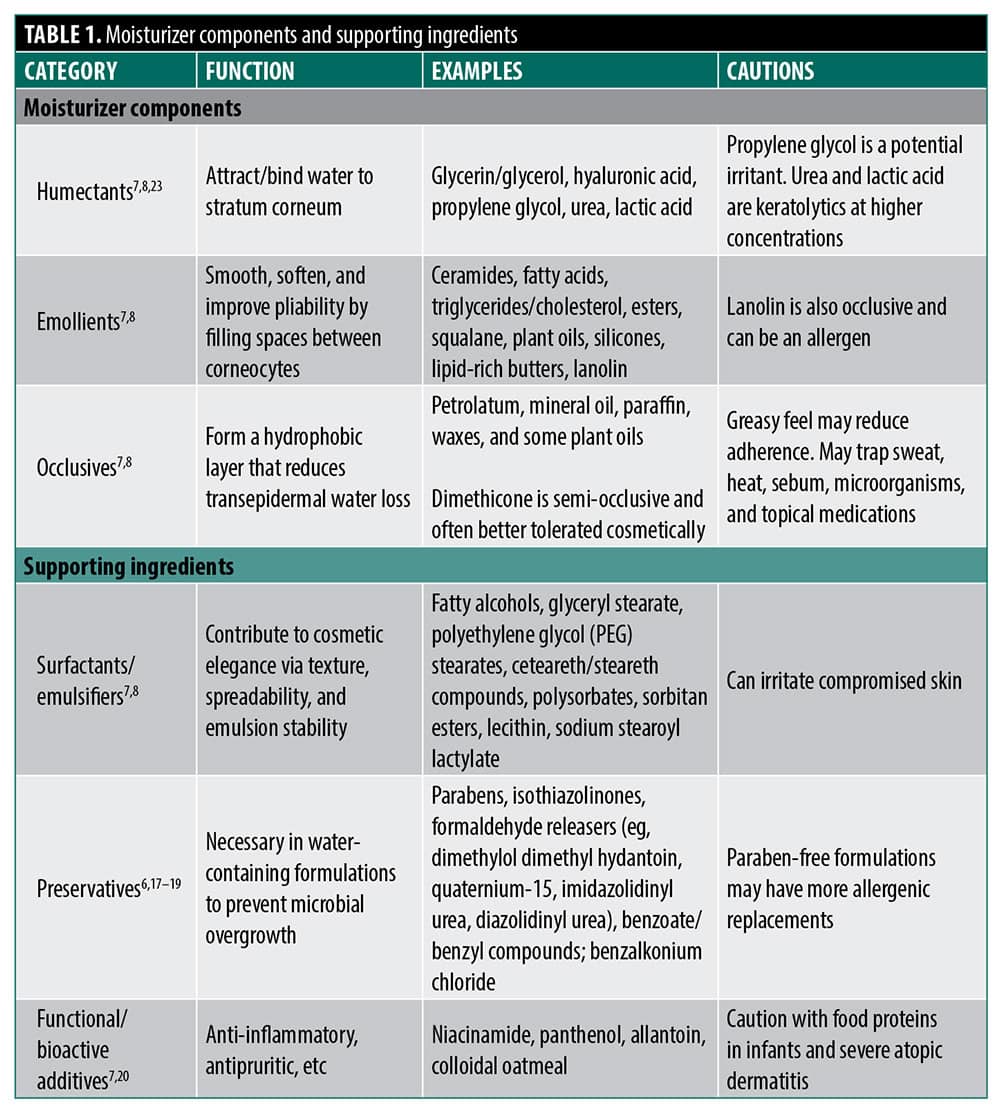
“Moisturizer” is an umbrella term for products that improve hydration or barrier function through different mechanisms (Table 1).7,8 In xerotic trunk and extremity presentations, a single formulation combining humectant, emollient, and occlusive properties is often preferable to layering multiple products due to improved ease of use and adherence with reduced cost and decreased exposure to excipients.7,8 However, a targeted approach may be better in select settings: petrolatum for fissured fingertips, a light humectant lotion for acne-prone facial skin, or barrier paste for moisture-associated dermatitis. In the Best Emollients for Eczema (BEE) trial, lotions, creams, gels, and ointments showed no clear class superiority for childhood eczema, suggesting that, except in special circumstances (outlined below), patient preference is often the primary determining factor, as efficacy is highly dependent on adherence.10
Normal Skin
Routine daily moisturization has no clearly established benefit in healthy, asymptomatic skin.3,4,8 While there is no definitive evidence that moisturizers permanently suppress endogenous natural moisturizing factors, unnecessary or poorly formulated moisturizers may alter hydration gradients and corneocyte cohesion, which may contribute to perceived dryness when the product is stopped.8 Moreover, some studies suggest that long-term use may increase susceptibility to irritants and sensitization to allergens.4,6 Consider the recommendation for daily moisturizing especially in individuals who exhibit phenotypically dry skin, individuals with sensitive skin, and those with skin conditions that are inherently associated with barrier impairment (eg, atopic skin, rosacea); in cases where topical medications produce or exacerbate skin irritation by inducing barrier impairments directly or indirectly; or as needed for seasonal, travel-related, or product-induced xerosis.1,2,10
A debate regarding the potential value of “automatic” skin moisturization every day also applies to normal infant skin. For those with a genetic predilection for atopy, data have been surprisingly mixed. The Barrier Enhancement for Eczema Prevention randomized trial found that daily emollient use in high-risk infants did not prevent atopic dermatitis (AD) by 24 months and was associated with more skin infections.11 Similarly, the Preventing Atopic Dermatitis and ALLergies in Children study (NCT02449850) found no reduction of AD by 12 months from emollient use in the general infant population.12 In contrast, the Community-based Assessment of Skin Care, Allergies, and Eczema study (NCT03409367) found a lower cumulative AD incidence by 24 months among infants in the United States (US) not selected for high AD risk who had daily full-body emollient use before 9 weeks of age.13 In a nutshell, “the jury is still out on this one.” As clinicians, we await more information, as this is an important area clinically, especially if the subsequent development of the “atopic march” can be positively affected to reduce the frequency and/or severity of subsequent atopic disorders over time, such as asthma, eosinophilic esophagitis, and allergic rhinitis.
Eczematous Dermatitis
In AD and other eczematous dermatoses, moisturizers reduce symptoms, improve objective disease measures, and prolong remission.14,15 While moisturizers may reduce reliance on topical medications including corticosteroids, vehicles can alter drug delivery. Occlusive vehicles may increase penetration (and therefore potency), whereas easily spreadable humectant- and emollient-based formulations may dilute concentration and disperse active drug beyond intended sites, particularly if mixed in the palm first or layered too rapidly. A practical approach is to moisturize the broader dry area, including after bathing or handwashing and gently patting away excess water, then apply topical medication to active lesions/areas after a short time interval when feasible.8,15,16
Impaired barriers are more permeable, increasing susceptibility to irritants found in moisturizers. In the BEE trial, more than one-third of children reported adverse reactions such as worsening erythema, dryness, pruritus, or stinging.10
Allergic contact dermatitis is also clinically relevant in the context of barrier dysfunction, as repeated, leave-on application makes moisturizers ideal vehicles for sensitization. Xu et al5 found that most best-selling moisturizers contained at least 1 North American Contact Dermatitis Group screening-series allergen. Fragrance mix, preservatives, and tocopherol (a vitamin E-derived antioxidant) were among the most common allergens noted. Clinicians should instruct patients to buy “fragrance-free,” not “unscented,” as the latter may contain masking fragrances, and to be aware that “paraben-free” should not be assumed safer. Parabens have relatively low sensitization rates, and removing them may require substitution with alternative preservatives including isothiazolinones or benzoate/benzyl compounds with greater sensitization concerns.6,17–19
Natural ingredients such as essential oils, botanicals, lanolin, propolis, and food-derived proteins including oat, wheat, milk, and nut components may also trigger irritant or allergic contact dermatitis in patients with impaired barriers or relevant food allergy.6,20
Organic ultraviolet filters in daytime moisturizers, particularly benzophenones such as oxybenzone and agents such as octocrylene, are also occasional causes of allergic and photoallergic contact dermatitis.21
Infection
When the clinical presentation warrants suspicion of a significant confounding diagnosis, it is prudent for clinicians to pause moisturization and evaluate for secondary bacterial infection, eczema herpeticum, or another diagnosis before escalating barrier therapy.3,11
Compared to tubes or pumps, tubs of water-containing emulsions carry a higher risk of microbial inoculation from repeated exposure to fingers, air, and humidity. Manufacturers may account for this through preservative systems that may increase irritant or allergen exposure. If the preferred product is not available in a tube or pump, wash hands before use or consider removing the desired quantity with a disposable utensil such as a tongue depressor.3,6,17–19
Other Dermatoses and Concerns
Heavy, occlusive moisturizers can potentially aggravate follicular disorders such as acne, folliculitis, perioral dermatitis, miliaria, and sweat-related itch. However, moisturizers are often useful as supportive adjuncts in these conditions and improve adherence to treatment regimens with topical medications such as benzoyl peroxide, salicylic acid, or topical/oral retinoids used to treat them.22 Consider lightweight lotions, targeted application, and avoidance before exercise.
For diaper/incontinence dermatitis, irritant dermatitis from saliva, peristomal irritation, or frictional intertrigo, the use of barrier paste is recommended to protect against external moisture and irritation.7
For rosacea and neurosensitive skin, moisturizers can reduce skin sensitivity and intolerance to prescription therapies. Avoidance of heavy formulations and products containing drying alcohols is suggested, the latter including “short-chain” alcohols such as ethanol and isopropyl alcohol.7
For aging skin, moisturizers may transiently improve the appearance of fine lines by increasing stratum corneum hydration and reducing scale. Exfoliating and active additives such as vitamin C, retinols, glycolic acid, and salicylic acid may improve skin texture or dyspigmentation, but high concentrations or overuse may result in barrier impairment; these are best avoided on inflamed, shaved, fissured, or intertriginous skin.7,8
Beyond the Recommendation
As with medications, moisturizers are not a one-size-fits-all recommendation, so reassessing tolerability at follow-up visits is imperative. Ask patients if they are satisfied with the moisturizer they are using and whether they are experiencing untoward effects such as stinging, burning, itching, or any “rashes or bumps.”3,6,10
If dermatitis worsens or develops following moisturizer application, suspect an occult irritant or allergen in the formulation. If the patient complains that “everything burns,” it is reasonable to suggest propylene glycol-free formulations, as it is an effective humectant at low concentrations but can become an irritant or allergen at higher concentrations. In chronic cheilitis, flavorings, colorants, and “medicated” components may be the offending agents. If eliminating these is not effective, have a low threshold for patch testing.6,23
Conclusion
Moisturizers are important components of many therapeutic regimens and warrant thoughtful consideration when assisting patients in choosing a product that best suits their individual needs. Product selection warrants attention to various factors similar to those given when selecting topical medications: patient phenotype, indication, site, vehicle, excipients, and tolerability. Marketing claims such as “hypoallergenic” or “for sensitive skin” are unreliable indicators of low irritant or allergen risk.5,6 Clinicians who understand common functional and supporting ingredients can better navigate the crowded moisturizer marketplace, recommend appropriate products, and withhold use of a moisturizer when necessary due to suspicion of adverse effects or in clinical situations where use may not be optimal. Many patients perceive the difference and are appreciative of the additional time, attention, and expertise given to them by a clinician or staff member who exerts the extra effort to personalize their care.
References
- Del Rosso JQ, Levin J. The clinical relevance of maintaining the functional integrity of the stratum corneum in both healthy and disease-affected skin. J Clin Aesthet Dermatol. 2011;4(9):22–42.
- Rajkumar J, Chandan N, Lio P, Shi V. The skin barrier and moisturization: function, disruption, and mechanisms of repair. Skin Pharmacol Physiol. 2023;36(4):174–185.
- Nedorost S. A sticky mess-are moisturizers overused in dermatitis care? J Am Acad Dermatol. 2024;91(6):1171–1176.
- Held E, Sveinsdóttir S, Agner T. Effect of long-term use of moisturizer on skin hydration, barrier function and susceptibility to irritants. Acta Derm Venereol. 1999;79(1):49–51.
- Xu S, Kwa M, Lohman ME, et al. Consumer preferences, product characteristics, and potentially allergenic ingredients in best-selling moisturizers. JAMA Dermatol. 2017;153(11):1099–1105.
- Zirwas MJ, Stechschulte SA. Moisturizer allergy: diagnosis and management. J Clin Aesthet Dermatol. 2008;1(4):38–44.
- Purnamawati S, Indrastuti N, Danarti R, Saefudin T. The role of moisturizers in addressing various kinds of dermatitis: a review. Clin Med Res. 2017;15(3–4):75–87.
- Lodén M. Effect of moisturizers on epidermal barrier function. Clin Dermatol. 2012;30(3):286–296.
- Del Rosso JQ, Kircik L. Skin 101: understanding the fundamentals of skin barrier physiology-why is this important for clinicians? J Clin Aesthet Dermatol. 2025;18(2):7–15.
- Ridd MJ, Santer M, MacNeill SJ, et al. Effectiveness and safety of lotion, cream, gel, and ointment emollients for childhood eczema: a pragmatic, randomised, phase 4, superiority trial. Lancet Child Adolesc Health. 2022;6(8):522–532.
- Chalmers JR, Haines RH, Bradshaw LE, et al; BEEP study team. Daily emollient during infancy for prevention of eczema: the BEEP randomised controlled trial. Lancet. 2020;395(10228):962–972.
- Skjerven HO, Rehbinder EM, Vettukattil R, et al. Skin emollient and early complementary feeding to prevent infant atopic dermatitis (PreventADALL): a factorial, multicentre, cluster-randomised trial. Lancet. 2020;395(10228):951–961.
- Simpson EL, Michaels LC, Ramsey K, et al; CASCADE Consortium. Emollients to prevent pediatric eczema: a randomized clinical trial. JAMA Dermatol. 2025;161(9):957–965.
- Sidbury R, Alikhan A, Bercovitch L, et al. Guidelines of care for the management of atopic dermatitis in adults with topical therapies. J Am Acad Dermatol. 2023;89(1):e1–e20.
- van Zuuren EJ, Fedorowicz Z, Christensen R, et al. Emollients and moisturizers for eczema. Cochrane Database Syst Rev. 2017;2(2):CD012119.
- Ng SY, Begum S, Chong SY. Does order of application of emollient and topical corticosteroids make a difference in the severity of atopic eczema in children? Pediatr Dermatol. 2016;33(2):160–164.
- Sasseville D. Hypersensitivity to preservatives. Dermatol Ther. 2004;17(3):251–263.
- de Groot AC, White IR, Flyvholm MA, et al. Formaldehyde-releasers in cosmetics: relationship to formaldehyde contact allergy. Contact Dermatitis. 2010;62(1):2–17.
- Fransway AF, Fransway PJ, Belsito DV, Yiannias JA. Paraben toxicology. Dermatitis. 2019;30(1):32–45.
- Pootongkam S, Nedorost S. Oat and wheat as contact allergens in personal care products. Dermatitis. 2013;24(6):291–295.
- Heurung AR, Raju SI, Warshaw EM. Adverse reactions to sunscreen agents: epidemiology, responsible irritants/allergens, clinical characteristics, and management. Dermatitis. 2014;25(6):289–326.
- Del Rosso JQ. The role of skin care as an integral component in the management of acne vulgaris: part 1: the importance of cleanser and moisturizer ingredients, design, and product selection. J Clin Aesthet Dermatol. 2013;6(12):19–27.
- McGowan MA, Scheman A, Jacob SE. Propylene glycol in contact dermatitis: a systematic review. Dermatitis. 2018;29(1):6–12.
From the 2nd Annual RAPIDS Immuno-Dermatology Conference: From Approval to Adoption—Translating Innovation Into Clinical Practice