
J Clin Aesthet Dermatol. 2026;19(9–10 Suppl 1):S10–S12.
Andrew Baker, MPAS, MBA, PA-C; and Avery Dinallo, DNP, FNP-C, DNCB
Mr. Baker is with DOCS Dermatology Group, Columbus, Ohio. Dr. Dinallo is with Allme Health, Meridian, Idaho.
Funding: No funding was provided for this article.
Disclosures: The authors have no relevant conflicts of interest.
Abstract: Background: Dermatology is experiencing increasing demand driven by aging populations, rising skin cancer incidence, and expanding use of advanced therapeutics. Concurrent workforce maldistribution and modest physician growth have created persistent access constraints, while increasing therapeutic and operational complexity has reshaped care delivery. Objective: To characterize dermatology workforce trends, including the expanding role of nurse practitioners (NPs) and physician assistants (PAs), and to contextualize these changes within evolving therapeutic complexity, educational needs, and care delivery systems. Methods: A retrospective analysis of the Centers for Medicare & Medicaid Services (CMS) Physician/Supplier Procedure Summary (PSPS) dataset and Medicare Part D Prescriber Public Use Files was performed. Evaluation and management (E/M) codes were used as proxies for outpatient encounters. Findings were interpreted in the context of contemporary workforce and clinical literature. Results: Dermatologists continue to deliver the majority of dermatologic care and remain central to diagnostic and procedural management. NP/PA participation has expanded significantly, with prescribers increasing from 2,707 in 2013 to 6,819 in 2022 and associated specialty medication spending rising from $24 million to $744 million. By 2022, NPs/PAs accounted for approximately 31.2% of dermatology-related specialty drug spending. Care delivery is increasingly collaborative and reflects more integrated, team-based models. Conclusion: Dermatology workforce evolution reflects a system-level response to increasing demand and therapeutic complexity. However, workforce expansion alone is insufficient to ensure consistent, high-quality care delivery. Future progress will depend on aligning workforce structure, shared educational access, and operational models to support reliable implementation of modern dermatologic therapies across care teams. Keywords: Dermatology workforce, nurse practitioners, physician assistants, advanced practice clinicians, team-based care, therapeutic complexity, clinical education, care delivery
Introduction
Dermatology is undergoing a structural transformation driven by rising clinical demand, increasing therapeutic complexity, and persistent workforce constraints. The growing burden of skin cancer, chronic inflammatory skin diseases, and the expanding use of biologic and targeted therapies have elevated both the volume and sophistication of care delivery.1,2 At the same time, growth in the dermatologist workforce has remained modest and unevenly distributed. Current estimates suggest approximately 11,000 to 13,000 practicing dermatologists in the United States, with significant geographic maldistribution and ongoing access gaps, particularly in nonmetropolitan regions.2,3
Within this evolving landscape, nurse practitioners (NPs) and physician assistants (PAs), also referred to as advanced practice clinicians (APCs), have become an increasingly important component of dermatologic care delivery. Medicare data demonstrate that NPs/PAs represented approximately 27.7% of dermatology clinicians in 2013, increasing to approximately 37.0% by 2020, with their share of dermatologic office visits rising from 15.5% to 27.4%.4 Prior analyses further demonstrated that NP/PA care is predominantly delivered within collaborative practice environments and closely integrated with physician care delivery.4,5
This evolution reflects a broader shift in dermatology from a primarily procedural and episodic specialty to one that increasingly requires longitudinal disease management, therapeutic monitoring, and coordination across complex treatment pathways.6,7 As this complexity grows, the ability to deliver consistent, high-quality care is influenced not only by workforce composition, but also by how effectively clinicians across the care team are trained, supported, and continuously educated.
Methods
This retrospective workforce analysis utilized Centers for Medicare & Medicaid Services (CMS) Physician/Supplier Procedure Summary (PSPS) data and Medicare Part D Prescriber Public Use Files, supplemented by peer-reviewed literature on dermatology workforce trends.
Outpatient encounters were approximated using evaluation and management (E/M) codes (99202–99205, 99211–99215). Because PSPS is a claim-line dataset, services billed under dermatologist specialty codes can include NP/PA-delivered care under incident-to billing arrangements, potentially underestimating total NP/PA contribution.6 Forward-looking projections for 2025 were generated using compound annual growth rates derived from Medicare Part D data from 2013 to 2022.6 These projections represent modeled estimates and should be interpreted accordingly.
Results
Dermatologists continue to provide the majority of dermatologic evaluation and management services and remain central to diagnostic decision-making, procedural care, and the management of complex diseases.6,7
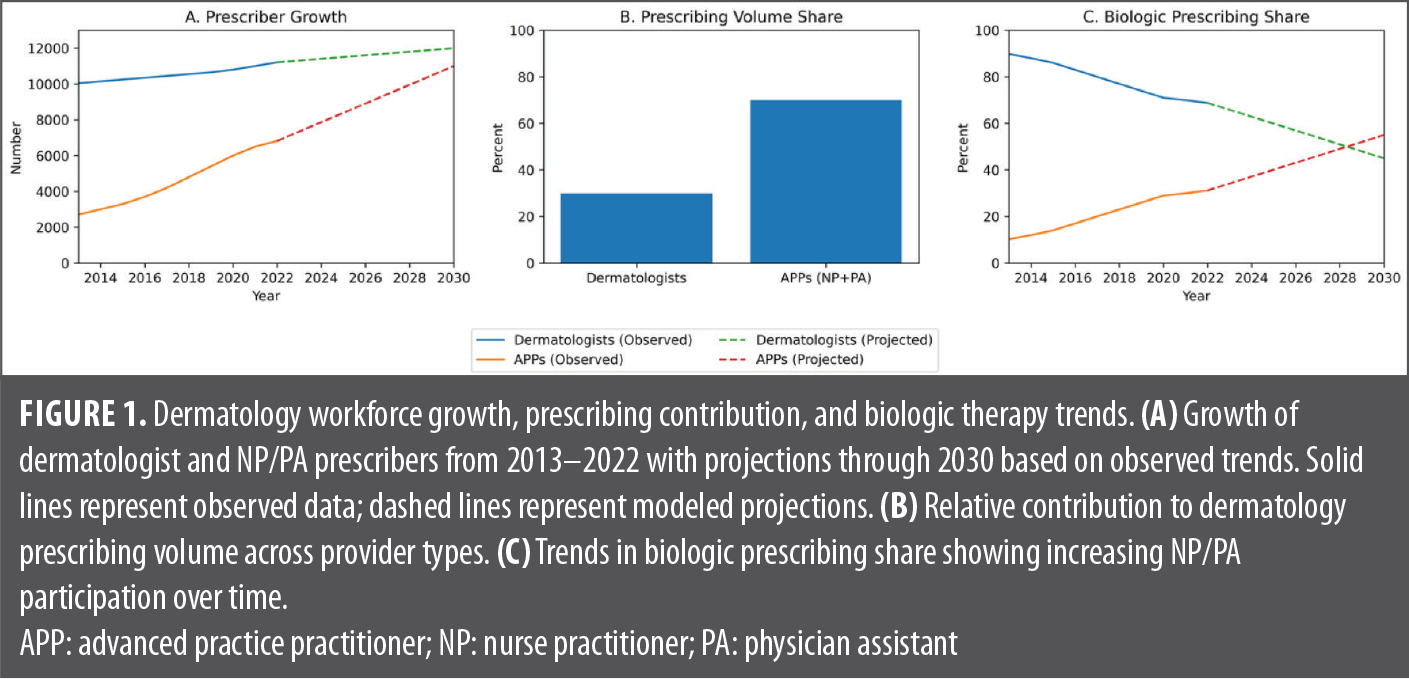
NP/PA participation has expanded substantially over the past decade. Dermatology-specific NP/PA prescribers increased from 2,707 in 2013 to 6,819 in 2022, while dermatologist prescribers increased from 10,048 to 11,208 during the same period.6 This growth is particularly evident in therapeutic management. Specialty drug spending associated with NPs/PAs increased from $24 million in 2013 to $744 million in 2022, with NP/PA share rising from 10.2% to 31.2% of dermatology-related specialty drug spending.6
Trend-based projections suggest continued expansion, with NPs/PAs approaching 40% to 45% of dermatology prescribers by 2025.6 Despite this growth, workforce distribution remains uneven, with approximately 30% of the United States population residing in dermatology-underserved areas.2,3
These trends are illustrated in Figure 1. Figure 1A demonstrates the longitudinal growth of both dermatologist and NP/PA prescribers, with a widening slope reflecting greater expansion in NP/PA participation over time. Figure 1B highlights the redistribution of prescribing volume across provider types, while Figure 1C illustrates the increasing share of biologic therapy prescribing attributable to NPs/PAs.
Discussion
The expansion of NPs/PAs in dermatology reflects a broader evolution in care delivery. As clinical demand increases and therapeutic pathways become more complex, care has become more distributed across integrated teams.1,7 Within these models, clinician roles span the continuum of care, including diagnostic evaluation, procedural management, longitudinal disease monitoring, patient education, and therapeutic coordination.4,5 Contemporary care models increasingly reflect a transition toward integrated, co-executed care pathways, in which dermatologists and NPs/PAs function within aligned clinical, educational, and operational frameworks.4,7
As shown in Figure 1, this evolution reflects not only growth in workforce participation (Figure 1A), but also a redistribution of prescribing responsibility (Figure 1B) and increasing involvement in complex therapeutic management, including biologic therapies (Figure 1C). NPs/PAs increasingly contribute to the implementation layer of care delivery, supporting execution of complex treatment plans, particularly in chronic inflammatory disease and biologic therapy management.6,7 As therapeutic innovation continues to accelerate, the limiting factor in care delivery is less often the availability of novel treatments and more often the ability to consistently operationalize these therapies across diverse clinical settings.1,8
In parallel with these clinical responsibilities, contributions across the dermatology care team are extending beyond direct patient care into education, research participation, and dissemination of clinical insights. NPs/PAs are increasingly involved in clinical trial execution, real-world evidence generation, peer-reviewed authorship, and educational initiatives, typically in collaboration with dermatologists and within established clinical and academic structures.4,7
A central implication of these findings is that workforce expansion alone is insufficient to meet the demands of modern dermatology. As therapeutic complexity increases, so does the need for more intentional, continuous, and accessible education across all clinicians involved in care delivery.7,9 This includes ongoing access to high-quality conferences, peer-reviewed journals, digital and asynchronous learning platforms, and case-based education. Ensuring that both physicians and NPs/PAs have access to shared educational environments is critical to maintaining consistency in clinical decision-making and therapeutic management.8,9
As care delivery models evolve, there is increasing recognition that clinical proficiency alone is insufficient to support consistent, high-quality dermatologic care. Foundational understanding of health system operations, including reimbursement structures, documentation optimization, and workflow design, has become increasingly relevant. Integrating operational literacy into ongoing education might further align clinical decision-making with real-world care delivery constraints and improve both efficiency and patient outcomes.
At the same time, variability in diagnostic concordance across clinician types reported in prior literature reinforces the importance of continued dermatology-specific training and collaborative care models. As case complexity increases, particularly in skin cancer and inflammatory dermatoses, maintaining consistent diagnostic accuracy remains essential. This supports the need for competency-based, longitudinal education frameworks that are accessible across the care team and reinforced through clinical collaboration.
Emerging digital education models, including teledermatology and Extension for Community Healthcare Outcomes (ECHO)–based frameworks, offer scalable mechanisms to extend subspecialty expertise and support ongoing clinician development. Sustained participation in these models has been associated with increasing case complexity and improved diagnostic confidence, suggesting value as part of broader continuing education infrastructure.
The rapid expansion of biologics, Janus kinase inhibitors, and other targeted therapies has further increased the clinical and operational complexity of dermatologic care. Effective implementation increasingly depends on clearly defined, team-based care pathways that align roles across dermatologists, NPs/PAs, and ancillary staff. Framing these models as operational alignment, rather than workforce substitution, more accurately reflects the coordinated effort required to safely and consistently deliver modern therapies.
Dermatology practice models, including large group practices and private equity–backed platforms, increasingly emphasize team-based care, operational efficiency, and scalability.10 These models reflect a broader shift toward aligning workforce structure with the operational demands of modern care delivery, where access, throughput, and consistency must be balanced with increasing clinical complexity.
Emerging organizational data suggest increasing formalization of NP/PA leadership roles across health systems, spanning clinical oversight, operational management, and strategic alignment. These roles are increasingly supported by compensation and incentive structures aligned with administrative, clinical, and performance-based responsibilities, reflecting broader recognition of contributions to care delivery and organizational outcomes.11
Dermatology has evolved into a systems-based specialty requiring integration of immunologic understanding, advanced therapeutics, and longitudinal care models.1,8 As these demands increase, care delivery depends on how well workforce capability aligns with this complexity. In the absence of accessible, high-quality educational infrastructure, variability in diagnostic approaches, delayed recognition of high-risk conditions, and inconsistencies in therapeutic selection could emerge. Conversely, when clinicians are supported through shared learning environments, these models can enhance consistency, improve efficiency, and strengthen patient outcomes.7
Limitations. This analysis has several limitations. CMS datasets might underrepresent NP/PA contributions due to incident-to billing structures that attribute services to supervising dermatologists. Evaluation and management coding was used as a proxy for clinical activity and might not fully capture care complexity. Medicare-based datasets might not reflect trends in privately insured or younger populations. Additionally, workforce projections are based on historical growth trends and should be interpreted as modeled estimates rather than predictive outcomes.
Conclusion
Dermatology is evolving in response to increasing demand, rising therapeutic complexity, and changing workforce dynamics. Dermatologists remain central to the diagnosis and management of complex dermatologic disease, while NPs/PAs play an expanding role in supporting access, continuity, and implementation of increasingly complex care pathways within collaborative practice models.
Future progress will depend not only on workforce composition, but on how effectively care teams are structured to deliver consistent, high-quality care. Aligning clinical roles, operational workflows, and educational access across the dermatology care team will be essential to translating therapeutic innovation into reliable, real-world clinical execution.
References
- Sargen MR, Shi L, Hooker RS, Chen SC. Future growth of physicians and non-physician providers within the U.S. dermatology workforce. Dermatol Online J. 2017;23(9):1–7.
- Yoo JY, Rigel DS. Trends in dermatology: geographic density of US dermatologists. Arch Dermatol. 2010;146(7):779.
- US physician workforce data dashboard. Association of American Medical Colleges. Accessed 18 Sep 2026. https://www.aamc.org/data-reports/report/us-physician-workforce-data-dashboard
- Mohr C, Li Y, Hinkston CL, et al. Trends over time in Medicare for advanced practice clinicians in dermatology, 2013-2020. JAMA Dermatol. 2023;159(8):859–863.
- Adamson AS, Suarez EA, McDaniel P, et al. Geographic distribution of nonphysician clinicians who independently billed Medicare for common dermatologic services in 2014. JAMA Dermatol. 2018;154(1):30–36.
- Kong EL, Mostaghimi A. Advanced practice clinicians and dermatology drug spending. JAMA Dermatol. 2026;162(2):207–209.
- Abraham I, Adamson AS, Shinkai K. Biologics prescribing in dermatology by advanced practice clinicians—trends in the practice of advanced practice clinicians in dermatology. JAMA Dermatol. 2026;162(2):209–210.
- Glazer AM, Rigel DS. Analysis of trends in geographic distribution of US dermatology workforce density. JAMA Dermatol. 2017;153(5):472–473.
- Young PA, Middleton HT, Griffith CF, et al. Expert consensus recommendations on dermoscopy proficiency standards for physician assistants: results of a modified Delphi survey. J Dermatol Physician Assist. 2025;19(1):14–19.
- Tan S, Seiger K, Renehan P, Mostaghimi A. Trends in private equity acquisition of dermatology practices in the United States. JAMA Dermatol. 2019;155(9):1013–1021.
- 2025 Advanced Practice Provider Compensation and Workforce Insights. SullivanCotter. 2025. Accessed 18 Sep 2026. https://sullivancotter.com/resources/infographic-2025-app-compensation
From the 2nd Annual RAPIDS Immuno-Dermatology Conference: From Approval to Adoption—Translating Innovation Into Clinical Practice