J Clin Aesthet Dermatol. 2026;19(9–10 Suppl 1):S14–S16.
Eileen Cheever, MPAS, PA-C, CAQ-Derm
Ms. Cheever is with Clearview Dermatology, Leominster, Massachusetts.
Funding: No funding was provided for this article.
Disclosures: The authors have no relevant conflicts of interest.
Editor’s Note: This column was developed in partnership with Elevate-Derm Alliance.
Abstract:The rapid expansion of United States Food and Drug Administration (FDA)–approved therapies in dermatology has created unprecedented opportunities to improve patient outcomes. However, the translation of these advances into routine clinical practice remains complex, particularly in community-based settings where physician assistants (PAs) and nurse practitioners (NPs) deliver a substantial proportion of care in high-volume environments. This review examines the multifactorial drivers that influence the adoption of new dermatologic therapies beyond clinical efficacy and safety. Key factors include perceived risk and real-world accountability, administrative and access barriers, workflow constraints, challenges in knowledge translation, and the influence of practice environment and clinical culture. Together, these elements shape how clinicians integrate emerging therapies into everyday decision-making. Strategies to support adoption are discussed, including the integration of clinical trial and real-world evidence, development of practical decision-support tools, expansion of advanced practice provider–focused education and peer learning, and reduction of administrative burden. Bridging the gap between innovation and implementation requires coordinated, patient-centered approaches that align evidence with the realities of clinical practice. Enhancing support for dermatology PAs and NPs is essential to ensuring consistent and timely application of therapeutic advances into real-world care. Keywords: Workflow, innovation, education, access, real-world practice, prior authorization
Introduction
The rapid expansion of United States Food and Drug Administration (FDA)–approved therapies in dermatology has ushered in an era of unprecedented therapeutic possibility. Yet, the translation of these advances into everyday clinical practice remains complex, particularly within community-based settings where dermatology physician assistants (PAs) and nurse practitioners (NPs) deliver a substantial proportion of care in high-volume environments.1 In these settings, the pathway from regulatory approval to routine clinical use is not solely determined by efficacy and safety data; rather, it is shaped by how clinicians interpret, contextualize, and integrate that information into day-to-day clinical workflows within the constraints of real-world practice.2 Understanding the dynamics that shape this process is essential to ensuring that therapeutic innovation ultimately reaches the patients it is intended to benefit. Against this backdrop, this manuscript examines the key determinants that influence the adoption of new dermatologic therapies in routine clinical practice and outlines strategies to facilitate their use in real-world care.
Understanding the Drivers of Context-Dependent Adoption
Perceived risk and real-world accountability. While clinical trials and conference discussions often emphasize efficacy and safety outcomes in controlled settings, community clinicians must apply these findings to patients with greater clinical variability and complexity. This shift can introduce a heightened sense of accountability, as adverse events or treatment failures are managed directly in real-world patient care settings. As a result, clinicians might adopt a more cautious approach to newer therapies, particularly those with limited long-term safety data or less familiarity in routine use. This cautious approach might be further influenced by differences in clinical experience, as clinicians earlier in practice or with less exposure to emerging therapies might have fewer opportunities to develop familiarity and confidence in their use.2 This pattern is consistent with broader evidence demonstrating that perceived risk and uncertainty influence whether clinicians incorporate new treatments into practice.3
Administrative and access barriers. Operational challenges remain one of the most significant barriers to adoption of novel dermatologic therapies. Prior authorization requirements, step therapy protocols, and formulary restrictions can delay or limit access, even when treatments are clinically appropriate.4 These processes introduce substantial administrative burden, often requiring additional time, staffing resources, and repeated follow-up. In many cases, the path of least resistance becomes the most practical choice during a busy clinic day. In high-volume practices, these constraints might influence clinicians to select therapies with more predictable access pathways, regardless of therapeutic efficacy and novelty. Prior studies and national survey data consistently demonstrate that prior authorization negatively impacts both clinician workflow and patient care delivery.4
Workflow integration and time constraints. Integrating new therapies into clinical practice requires more than familiarity with the medication itself; it also involves understanding any monitoring requirements, patient education, and follow-up logistics. In busy outpatient settings, where efficiency is essential, therapies that introduce additional coordination might be perceived as disruptive.2,3 Time constraints might limit opportunities to explore newer options during patient encounters, reinforcing reliance on familiar and streamlined treatment approaches. These findings align with broader literature identifying time pressure and workflow disruption as barriers to practice change.3
Knowledge translation and practical applicability. Although access to clinical trial data and continuing education has expanded, translating this information into actionable, patient-specific decisions remains challenging. Clinical trials often involve highly selected populations and structured protocols that might not fully reflect real-world dermatology practice. This gap underscores the need for approaches that support the translation of clinical evidence into real-world decision-making. This disconnect between evidence generation and real-world applicability has been well described and represents a key barrier to adoption across multiple specialties.5
Practice environment and clinical culture. Adoption of new therapies is also shaped by the broader practice environment, including institutional norms, supervising physician preferences, and established treatment patterns. In collaborative settings, PAs and NPs might align with group practice patterns or defer to more established approaches when introducing newer agents. Additionally, formulary limitations and health system policies further influence therapeutic decisions.3 These factors underscore that adoption is not solely an individual clinician choice, but one embedded within a larger organizational context.
Bridging the Gap: Strategies to Support Real-World Adoption
Integrating evidence, algorithms, and patient-centered decision-making. Supporting the adoption of newer therapies requires more than the availability of clinical data (Figure 1). It depends on how different forms of evidence are interpreted and applied within the context of individual patient care. Clinicians rely on randomized clinical trial data to understand efficacy and safety but often seek additional context to determine how these therapies will perform in patients who more closely resemble those seen in their practice. Real-world evidence provides this complementary perspective, offering insights into effectiveness, tolerability, and patterns of use across broader patient populations.5
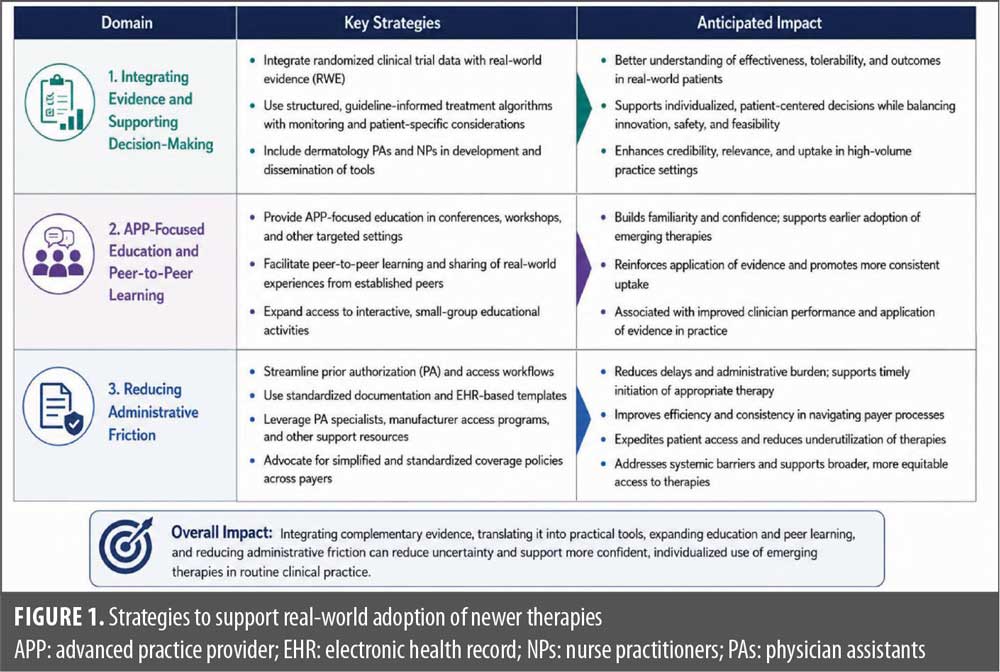
At the same time, adoption in clinical practice is not intended to be indiscriminate, but rather guided by thoughtful, context-aware decision-making. Clinicians must balance innovation with considerations of safety, feasibility, and patient-specific factors. Translating both trial and real-world data into practical, implementation-focused tools is therefore critical to supporting these decisions. Structured treatment approaches, such as guideline-informed algorithms that incorporate monitoring requirements and patient-specific considerations, can assist clinicians in navigating increasingly complex therapeutic landscapes while tailoring care to individual patients.6
Including dermatology PAs and NPs in the development and dissemination of these tools might enhance their relevance and uptake by reinforcing their credibility and applicability in real-world practice. Representation from peers working in similar high-volume, practice-based settings might further support engagement with and applicability of these tools. Together, integrating complementary evidence sources and translating them into structured, patient-centered guidance can reduce uncertainty and support more confident, individualized use of emerging therapies in routine clinical practice.
APP-focused education and peer-to-peer learning. Beyond the availability of evidence and tools, clinician familiarity and confidence are shaped by opportunities for ongoing education and peer engagement. Targeted, practice-relevant educational strategies represent a key opportunity to support the adoption of newer agents. In conference and educational settings, clinicians are exposed to new therapies in ways that can foster earlier familiarity and confidence in their use. These environments enable repeated engagement with evolving evidence, deeper exploration of mechanisms of action and safety profiles, and the exchange of shared clinical experiences. Learning from the experiences of established peers who have incorporated these therapies into practice can further reinforce confidence and help translate evidence into clinical decision-making.7
Differences in adoption might therefore be less reflective of clinician willingness and more indicative of variability in exposure to these learning environments. Participation in conferences and interactive, small-group educational activities has been associated with improvements in clinician performance and the application of clinical evidence in routine practice.8 Expanding access to these structured opportunities for shared learning might help bridge this experiential gap and support more consistent uptake of therapeutic advances in routine clinical practice.
Reducing administrative friction. Even when clinicians are equipped with the necessary knowledge and tools, administrative and access barriers can present challenges in translating treatment decisions into timely patient care. Complex prior authorization requirements, variable payer policies, and delays in treatment initiation can significantly limit timely access, even when clinicians are confident in a therapy’s clinical value.4
Streamlining prior authorization processes and improving access pathways represent important opportunities to reduce this burden. Standardized documentation, integration of electronic health record–based templates, and dedicated support resources such as prior authorization specialists might improve efficiency and reduce administrative strain on clinicians.9,10 Familiarity with payer-specific requirements and manufacturer-sponsored access programs can also help expedite patient access to therapy.
Perceived access barriers might not always reflect true limitations in coverage, but rather variability in awareness of available pathways to therapy. In high-volume practice settings, limited time to navigate and educate around these resources might contribute to underutilization. Expanding access to support services and improving clinician awareness of existing access programs represent actionable opportunities to improve the consistency and timeliness of therapy initiation.
At a broader level, coordinated advocacy efforts aimed at simplifying coverage policies and reducing variability across payers might help address systemic barriers that extend beyond individual practices.9 Together, these approaches can support more timely initiation of appropriate therapies and improve the consistency with which treatment advances are translated into patient care.
Conclusion
The rapid expansion of therapeutic options in dermatology has created unprecedented opportunity to improve patient outcomes. Yet, as this review demonstrates, the translation of these advances into routine clinical practice remains complex and context-dependent, shaped by factors that extend well beyond efficacy and safety alone.
Bridging this gap requires more than the generation of evidence. It involves strategies that integrate clinical trial data with real-world experience, translate findings into practical decision-support tools, expand access to targeted education, and reduce administrative barriers that limit timely treatment initiation. These efforts must be grounded in patient-centered decision-making, ensuring that therapeutic choices reflect both clinical evidence and the realities of individual patient care.
Dermatology PAs and NPs play a central role in this process, particularly within high-volume community settings where much of clinical care is delivered. Their inclusion in educational initiatives, peer-to-peer learning, and the development of clinical tools represents an important opportunity to enhance the relevance and uptake of emerging therapies.
Ultimately, the promise of therapeutic innovation in dermatology will be realized not at the point of approval, but in its consistent and thoughtful application in everyday clinical practice. Closing the gap between innovation and implementation is essential to ensuring that advances in care translate into meaningful benefit for patients.
References
- Mohr C, Li Y, Hinkston CL, et al. Trends over time in Medicare for advanced practice clinicians in dermatology, 2013-2020. JAMA Dermatol. 2023;159(8):859–863.
- Cabana MD, Rand CS, Powe NR, et al. Why don’t physicians follow clinical practice guidelines? A framework for improvement. JAMA. 1999;282(15):1458–1465.
- Greenhalgh T, Robert G, Macfarlane F, et al. Diffusion of innovations in service organizations: systematic review and recommendations. Milbank Q. 2004;82(4):581–629.
- 2024 AMA prior authorization physician survey. American Medical Association. 2024. Accessed 3 Sep 2026. https://fixpriorauth.org/sites/default/files/2025-02/2024_AMA_Prior-Authorization-Physician_Survey.pdf
- Corrigan-Curay J, Sacks L, Woodcock J. Real-world evidence and real-world data for evaluating drug safety and effectiveness. JAMA. 2018;320(9):867–868.
- Menter A, Strober BE, Kaplan DH, et al. Joint AAD-NPF guidelines of care for the management and treatment of psoriasis with biologics. J Am Acad Dermatol. 2019;80(4):1029–1072.
- Greszczuk C, Mughal F, Mathew R, Rashid A. Peer influence as a driver of technological innovation in the UK National Health Service: a qualitative study of clinicians’ experiences and attitudes. BMJ Innovations. 2018;4(2):68–74.
- Cervero RM, Gaines JK. The impact of CME on physician performance and patient health outcomes: an updated synthesis of systematic reviews. J Contin Educ Health Prof. 2015;35(2):131–138.
- Resneck JS Jr. Refocusing medication prior authorization on its intended purpose. JAMA. 2020;323(8):703–704.
- Consensus statement on improving the prior authorization process. American Medical Association. Jan 2018. Accessed 11 Mar 2026. https://www.ama-assn.org/sites/ama-assn.org/files/corp/media-browser/public/arc-public/prior-authorization-consensus-statement.pdf

From the 2nd Annual RAPIDS Immuno-Dermatology Conference: From Approval to Adoption—Translating Innovation Into Clinical Practice
Categories:
J Clin Aesthet Dermatol. 2026;19(9–10 Suppl 1):S14–S16.
Eileen Cheever, MPAS, PA-C, CAQ-Derm
Ms. Cheever is with Clearview Dermatology, Leominster, Massachusetts.
Funding: No funding was provided for this article.
Disclosures: The authors have no relevant conflicts of interest.
Editor’s Note: This column was developed in partnership with Elevate-Derm Alliance.
Abstract:The rapid expansion of United States Food and Drug Administration (FDA)–approved therapies in dermatology has created unprecedented opportunities to improve patient outcomes. However, the translation of these advances into routine clinical practice remains complex, particularly in community-based settings where physician assistants (PAs) and nurse practitioners (NPs) deliver a substantial proportion of care in high-volume environments. This review examines the multifactorial drivers that influence the adoption of new dermatologic therapies beyond clinical efficacy and safety. Key factors include perceived risk and real-world accountability, administrative and access barriers, workflow constraints, challenges in knowledge translation, and the influence of practice environment and clinical culture. Together, these elements shape how clinicians integrate emerging therapies into everyday decision-making. Strategies to support adoption are discussed, including the integration of clinical trial and real-world evidence, development of practical decision-support tools, expansion of advanced practice provider–focused education and peer learning, and reduction of administrative burden. Bridging the gap between innovation and implementation requires coordinated, patient-centered approaches that align evidence with the realities of clinical practice. Enhancing support for dermatology PAs and NPs is essential to ensuring consistent and timely application of therapeutic advances into real-world care. Keywords: Workflow, innovation, education, access, real-world practice, prior authorization
Introduction
The rapid expansion of United States Food and Drug Administration (FDA)–approved therapies in dermatology has ushered in an era of unprecedented therapeutic possibility. Yet, the translation of these advances into everyday clinical practice remains complex, particularly within community-based settings where dermatology physician assistants (PAs) and nurse practitioners (NPs) deliver a substantial proportion of care in high-volume environments.1 In these settings, the pathway from regulatory approval to routine clinical use is not solely determined by efficacy and safety data; rather, it is shaped by how clinicians interpret, contextualize, and integrate that information into day-to-day clinical workflows within the constraints of real-world practice.2 Understanding the dynamics that shape this process is essential to ensuring that therapeutic innovation ultimately reaches the patients it is intended to benefit. Against this backdrop, this manuscript examines the key determinants that influence the adoption of new dermatologic therapies in routine clinical practice and outlines strategies to facilitate their use in real-world care.
Understanding the Drivers of Context-Dependent Adoption
Perceived risk and real-world accountability. While clinical trials and conference discussions often emphasize efficacy and safety outcomes in controlled settings, community clinicians must apply these findings to patients with greater clinical variability and complexity. This shift can introduce a heightened sense of accountability, as adverse events or treatment failures are managed directly in real-world patient care settings. As a result, clinicians might adopt a more cautious approach to newer therapies, particularly those with limited long-term safety data or less familiarity in routine use. This cautious approach might be further influenced by differences in clinical experience, as clinicians earlier in practice or with less exposure to emerging therapies might have fewer opportunities to develop familiarity and confidence in their use.2 This pattern is consistent with broader evidence demonstrating that perceived risk and uncertainty influence whether clinicians incorporate new treatments into practice.3
Administrative and access barriers. Operational challenges remain one of the most significant barriers to adoption of novel dermatologic therapies. Prior authorization requirements, step therapy protocols, and formulary restrictions can delay or limit access, even when treatments are clinically appropriate.4 These processes introduce substantial administrative burden, often requiring additional time, staffing resources, and repeated follow-up. In many cases, the path of least resistance becomes the most practical choice during a busy clinic day. In high-volume practices, these constraints might influence clinicians to select therapies with more predictable access pathways, regardless of therapeutic efficacy and novelty. Prior studies and national survey data consistently demonstrate that prior authorization negatively impacts both clinician workflow and patient care delivery.4
Workflow integration and time constraints. Integrating new therapies into clinical practice requires more than familiarity with the medication itself; it also involves understanding any monitoring requirements, patient education, and follow-up logistics. In busy outpatient settings, where efficiency is essential, therapies that introduce additional coordination might be perceived as disruptive.2,3 Time constraints might limit opportunities to explore newer options during patient encounters, reinforcing reliance on familiar and streamlined treatment approaches. These findings align with broader literature identifying time pressure and workflow disruption as barriers to practice change.3
Knowledge translation and practical applicability. Although access to clinical trial data and continuing education has expanded, translating this information into actionable, patient-specific decisions remains challenging. Clinical trials often involve highly selected populations and structured protocols that might not fully reflect real-world dermatology practice. This gap underscores the need for approaches that support the translation of clinical evidence into real-world decision-making. This disconnect between evidence generation and real-world applicability has been well described and represents a key barrier to adoption across multiple specialties.5
Practice environment and clinical culture. Adoption of new therapies is also shaped by the broader practice environment, including institutional norms, supervising physician preferences, and established treatment patterns. In collaborative settings, PAs and NPs might align with group practice patterns or defer to more established approaches when introducing newer agents. Additionally, formulary limitations and health system policies further influence therapeutic decisions.3 These factors underscore that adoption is not solely an individual clinician choice, but one embedded within a larger organizational context.
Bridging the Gap: Strategies to Support Real-World Adoption
Integrating evidence, algorithms, and patient-centered decision-making. Supporting the adoption of newer therapies requires more than the availability of clinical data (Figure 1). It depends on how different forms of evidence are interpreted and applied within the context of individual patient care. Clinicians rely on randomized clinical trial data to understand efficacy and safety but often seek additional context to determine how these therapies will perform in patients who more closely resemble those seen in their practice. Real-world evidence provides this complementary perspective, offering insights into effectiveness, tolerability, and patterns of use across broader patient populations.5
At the same time, adoption in clinical practice is not intended to be indiscriminate, but rather guided by thoughtful, context-aware decision-making. Clinicians must balance innovation with considerations of safety, feasibility, and patient-specific factors. Translating both trial and real-world data into practical, implementation-focused tools is therefore critical to supporting these decisions. Structured treatment approaches, such as guideline-informed algorithms that incorporate monitoring requirements and patient-specific considerations, can assist clinicians in navigating increasingly complex therapeutic landscapes while tailoring care to individual patients.6
Including dermatology PAs and NPs in the development and dissemination of these tools might enhance their relevance and uptake by reinforcing their credibility and applicability in real-world practice. Representation from peers working in similar high-volume, practice-based settings might further support engagement with and applicability of these tools. Together, integrating complementary evidence sources and translating them into structured, patient-centered guidance can reduce uncertainty and support more confident, individualized use of emerging therapies in routine clinical practice.
APP-focused education and peer-to-peer learning. Beyond the availability of evidence and tools, clinician familiarity and confidence are shaped by opportunities for ongoing education and peer engagement. Targeted, practice-relevant educational strategies represent a key opportunity to support the adoption of newer agents. In conference and educational settings, clinicians are exposed to new therapies in ways that can foster earlier familiarity and confidence in their use. These environments enable repeated engagement with evolving evidence, deeper exploration of mechanisms of action and safety profiles, and the exchange of shared clinical experiences. Learning from the experiences of established peers who have incorporated these therapies into practice can further reinforce confidence and help translate evidence into clinical decision-making.7
Differences in adoption might therefore be less reflective of clinician willingness and more indicative of variability in exposure to these learning environments. Participation in conferences and interactive, small-group educational activities has been associated with improvements in clinician performance and the application of clinical evidence in routine practice.8 Expanding access to these structured opportunities for shared learning might help bridge this experiential gap and support more consistent uptake of therapeutic advances in routine clinical practice.
Reducing administrative friction. Even when clinicians are equipped with the necessary knowledge and tools, administrative and access barriers can present challenges in translating treatment decisions into timely patient care. Complex prior authorization requirements, variable payer policies, and delays in treatment initiation can significantly limit timely access, even when clinicians are confident in a therapy’s clinical value.4
Streamlining prior authorization processes and improving access pathways represent important opportunities to reduce this burden. Standardized documentation, integration of electronic health record–based templates, and dedicated support resources such as prior authorization specialists might improve efficiency and reduce administrative strain on clinicians.9,10 Familiarity with payer-specific requirements and manufacturer-sponsored access programs can also help expedite patient access to therapy.
Perceived access barriers might not always reflect true limitations in coverage, but rather variability in awareness of available pathways to therapy. In high-volume practice settings, limited time to navigate and educate around these resources might contribute to underutilization. Expanding access to support services and improving clinician awareness of existing access programs represent actionable opportunities to improve the consistency and timeliness of therapy initiation.
At a broader level, coordinated advocacy efforts aimed at simplifying coverage policies and reducing variability across payers might help address systemic barriers that extend beyond individual practices.9 Together, these approaches can support more timely initiation of appropriate therapies and improve the consistency with which treatment advances are translated into patient care.
Conclusion
The rapid expansion of therapeutic options in dermatology has created unprecedented opportunity to improve patient outcomes. Yet, as this review demonstrates, the translation of these advances into routine clinical practice remains complex and context-dependent, shaped by factors that extend well beyond efficacy and safety alone.
Bridging this gap requires more than the generation of evidence. It involves strategies that integrate clinical trial data with real-world experience, translate findings into practical decision-support tools, expand access to targeted education, and reduce administrative barriers that limit timely treatment initiation. These efforts must be grounded in patient-centered decision-making, ensuring that therapeutic choices reflect both clinical evidence and the realities of individual patient care.
Dermatology PAs and NPs play a central role in this process, particularly within high-volume community settings where much of clinical care is delivered. Their inclusion in educational initiatives, peer-to-peer learning, and the development of clinical tools represents an important opportunity to enhance the relevance and uptake of emerging therapies.
Ultimately, the promise of therapeutic innovation in dermatology will be realized not at the point of approval, but in its consistent and thoughtful application in everyday clinical practice. Closing the gap between innovation and implementation is essential to ensuring that advances in care translate into meaningful benefit for patients.
References
Share:
Recent Articles:
Radhika Srivastava, MD: Management of Pruritus in Pediatric Atopic Dermatitis
Understanding Opzelura: Clinical Evidence and Efficacy
Operational Alignment in Dermatology: Workforce Evolution, Therapeutic Complexity, and the Need for Intentional Education Across Care Teams
From the 2nd Annual RAPIDS Immuno-Dermatology Conference: From Approval to Adoption—Translating Innovation Into Clinical Practice
Selected Abstracts from GDPA Pearls Conference 2026
Categories:
Recent Articles:
A Proactive Approach to the Prevention and Management of Postinflammatory Hyperpigmentation
Lichen Planus in Skin of Color: Three Clinical Pearls for Recognition and Evaluation
Shaping Pediatric Dermatology Care: Clinical Pearls, Promoting Longevity, and Future Possibilities for Nurse Practitioners and Physician Assistants
Zelma Chiesa Fuxench, MD, MSCE: Atopic Dermatitis Patient Selection and Expectations for Ruxolitinib
James Q. Del Rosso, DO: Switching to Biologics for Moderate-to-Severe Psoriasis
Andrew Mastro, MS, PA-C: Practical Prescribing and Patient Communication for Ruxolitinib in Atopic Dermatitis
Lisa Ginn, MD: Mastering Hyperpigmentation in Skin of Color
Living with Vitiligo: From Diagnosis to Treatment
Willa Hsueh, MD: GLP-1 Receptor Agonists for Obesity and Associated Complications
Alisa Femia, MD: Emerging Advances in Dermatomyositis Treatment
Tags: