
J Clin Aesthet Dermatol. 2026;19(8):30–32.
Faraz Yousefian, DO*; Megan Khajeh-Afzaly, BS*; Gabriella Resnick, BA; Naiem T. Issa, MD, PhD; and Erik Domingues, MD
Dr. Yousefian is with the University of Incarnate Word, San Antonio, Texas and Emory Healthcare, Warner Robins, Georgia. Ms. Khajeh-Afzaly is with Edward Via College of Osteopathic Medicine, Blacksburg, Virginia. Ms. Resnick is with Georgetown University School of Medicine, Washington, District of Columbia. Dr. Issa is with Forefront Dermatology, Vienna, Virginia; the University of Miami Miller School of Medicine, Dr. Phillip Frost Department of Dermatology and Cutaneous Surgery, Miami, Florida; and the Department of Dermatology, George Washington University School of Medicine and Health Sciences, Washington, District of Columbia. Dr. Domingues is with the UMass Chan Medical School-Department of Dermatology, Worcester, Massachusetts, and Modern Dermatology of Massachusetts, PLLC, Fall River, Massachusetts.
*Co-first authors.
FUNDING: No funding was provided for this article.
DISCLOSURES: Dr. Issa has served as a speaker, consultant, advisor, or investigator for AbbVie, Almirall, Apogee, Boehringer Ingelheim, Botanix, Briston Myers Squibb, Castle Biosciences, DermTech, Galderma, Incyte, Janssen, Journey, LEO Pharma, Lilly, Novartis, Organon, Ortho Dermatologics, Pfizer, Primus, Regeneron, Sanofi, Sun Pharmaceuticals, Topix, UCB, and Verrica Pharmaceuticals. Dr. Domingues has served as a speaker, consultant, and/or advisor for AbbVie, Apogee, Arcutis, Briston Myers Squibb, Castle Biosciences, Galderma, Incyte, Janssen, LEO Pharma, Pelthos, Pfizer, UCB, and Veradermics. The remaining authors have no relevant conflicts of interest.
Abstract: Lichen planus pigmentosus (LPP) is an uncommon variant of lichen planus, characterized by dark-brown to gray-toned macules and papules and often accompanied by mild-to-moderate pruritus, that is often difficult to manage with conventional therapies. Topical corticosteroids and calcineurin inhibitors are commonly used but are often ineffective or associated with adverse effects, particularly in intertriginous areas. We report the case of a 36-year-old man with pruritic LPP of the proximal medial thighs refractory to topical corticosteroids and a calcineurin inhibitor. Monotherapy with roflumilast cream 0.3% was initiated. After 3 months of treatment, the pruritus resolved, with some initial lightening of the hyperpigmented macules. After another 4 months, there was near-complete resolution of the lesions, with the patient reporting significant improvement and satisfaction. This case highlights roflumilast as a promising nonsteroidal therapeutic option for refractory LPP, offering potential advantages in efficacy, safety, and patient adherence. Further studies are warranted to confirm its long-term outcomes and establish its role in the management of this condition. Keywords: Lichen planus pigmentosus, roflumilast, phosphodiesterase-4 (PDE4) inhibitor
Introduction
Lichen planus pigmentosus (LPP) is a rare variant of lichen planus characterized by the insidious onset of dark brown, gray, or blue-gray macules and papules on sun-exposed areas of the face and neck as well as sun-protected flexural skin such as the axillae and inguinal areas, commonly affecting patients with Fitzpatrick skin types III to IV.1 Although the etiology of LPP is unclear, the pathophysiology is thought to be immune-mediated with an altered cellular response mediated by T lymphocytes, in which CD4+ and CD8+ cells attack and destroy epidermal keratinocytes, causing pigmentary incontinence.1,2 External triggers such as gold, nickel, friction, psychological stress, sun exposure, and over-the-counter oils and cosmetics, and associated infectious conditions such as hepatitis C have been implicated.1
Currently, there are limited data regarding the efficacy of LPP treatments, which include topical corticosteroids, topical calcineurin inhibitors, oral corticosteroids, oral tranexamic acid, and isotretinoin. Roflumilast cream 0.3% is a potent topical phosphodiesterase-4 (PDE4) inhibitor approved in 2022 by the United States Food and Drug Administration (FDA) for the treatment of plaque psoriasis, including intertriginous disease, in patients aged 6 years and older.3 A separate foam formulation of roflumilast 0.3% received FDA approval for seborrheic dermatitis in patients aged 9 years and older in 2023, and for the treatment of plaque psoriasis of the scalp and body in patients aged 12 years and older in 2024. Roflumilast 0.15% cream was approved in August 2023 for atopic dermatitis in patients 6 years and older, while the 0.05% cream formulation was approved in October 2025 for atopic dermatitis in patients aged 2 to 5 years. Roflumilast is more potent than apremilast and crisaborole, with roflumilast binding 3 high-affinity sites of cyclic adenosine monophosphate (cAMP).4 Although no direct head-to-head randomized controlled trial comparing roflumilast and apremilast has been published to date, pharmacologic data consistently postulate and demonstrate that roflumilast is approximately 25- to 300-fold more potent than apremilast in PDE4 inhibition across multiple isoforms.4,5
This report presents a case of LPP that was pruritic and refractory to both topical corticosteroids and topical tacrolimus but showed marked improvement in symptoms and disease presentation with once-daily application of roflumilast cream 0.3%. To our knowledge, this is the first reported case of LPP improving with roflumilast cream 0.3%.
Case Presentation
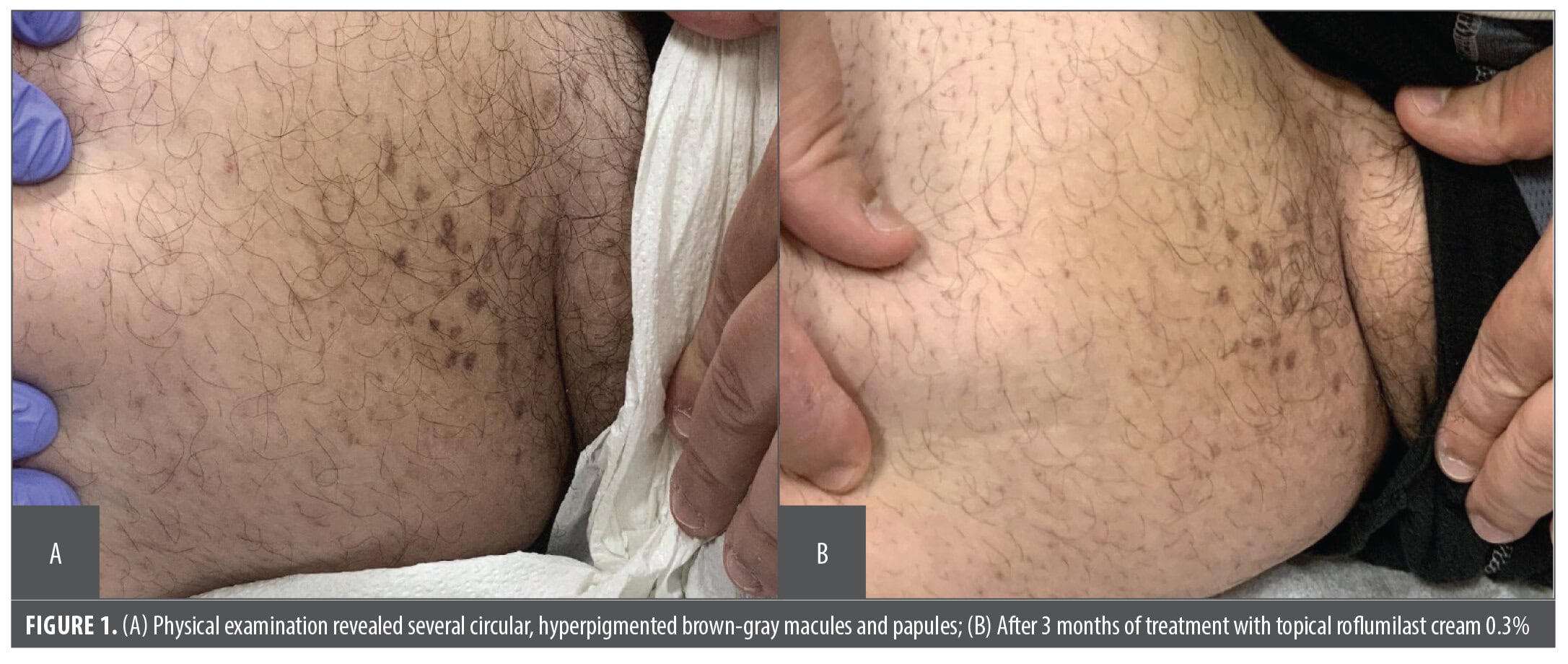
A 36-year-old man presented with a several-year history of a pruritic eruption on the medial thighs. On examination, there were several circular, hyperpigmented brown-gray macules and papules. Clobetasol ointment 0.05% applied twice daily in a 5-days-on/2-days-off regimen for 4 months was ineffective, and a punch biopsy was performed, confirming the diagnosis of LPP. As a result, tacrolimus ointment 0.1% twice daily was prescribed. At the patient’s 3-month follow up, he had no improvement in his LPP despite consistent use of tacrolimus. The patient declined the use of oral tranexamic acid due to its risk of thrombotic events. Given the lack of improvement, the patient was prescribed topical roflumilast cream 0.3% once daily as monotherapy. Further corticosteroid use was not advised at this time due to the intertriginous location and the risk of atrophy, striae, and fungal and yeast overgrowth (Figure 1A).
The patient returned for his next 3-month follow-up and reported resolution of pruritus and mild improvement in clinical appearance. Upon examination, irregular round- and oval-shaped, hyperpigmented lighter brown-gray macules and papules in the bilateral medial thighs appeared lighter in color. The patient elected to continue roflumilast since his main symptom, pruritus, had resolved (Figure 1B).
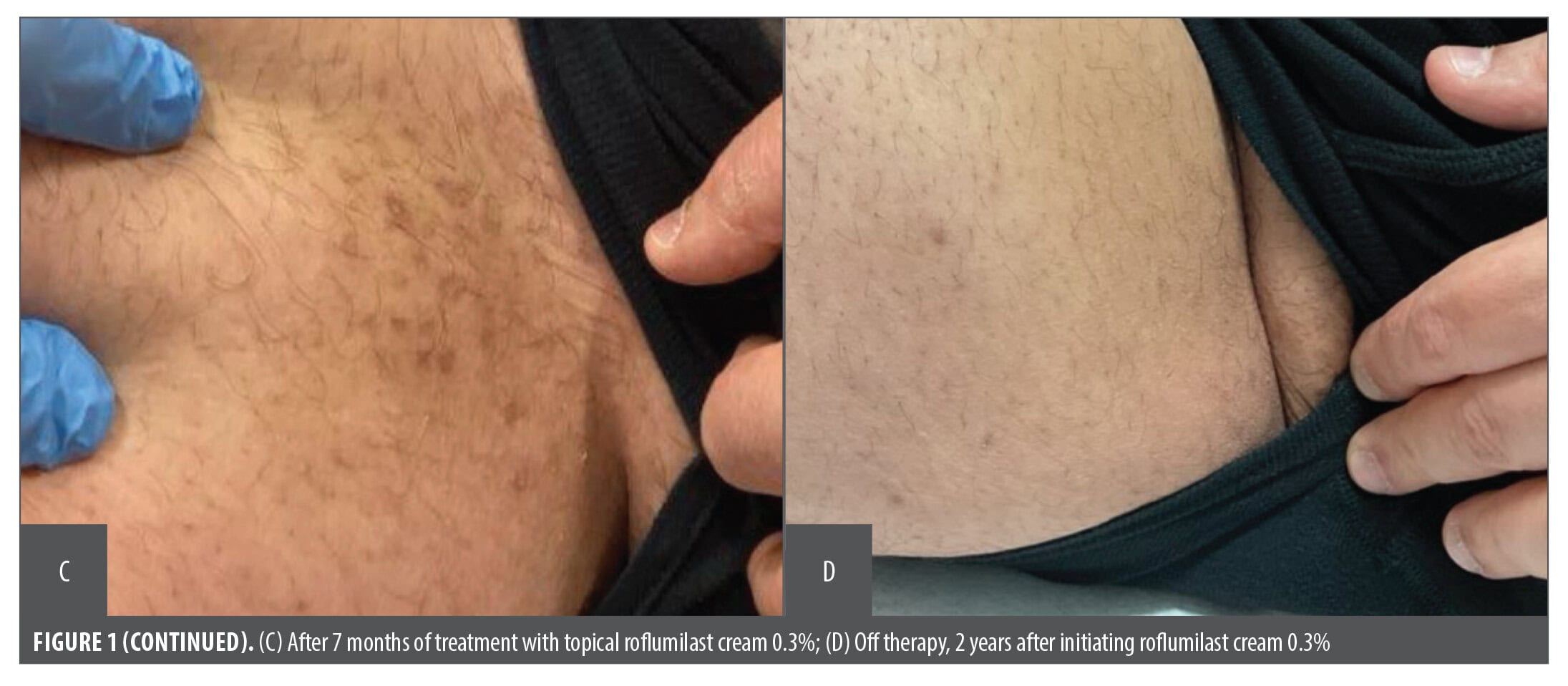
At his 7-month follow-up, the patient continued to use roflumilast cream 0.3% once daily with near-complete resolution of his LPP, with faint light-brown macules. The patient was pleased and elected to continue roflumilast cream 0.3% as needed (Figure 1C). Complete resolution without disease recurrence off treatment was noted 2 years after treatment initiation (Figure 1D).
Discussion
To the best of our knowledge, this is the first reported case of LPP treated with topical roflumilast cream 0.3%. A case report described the use of topical roflumilast in a 94-year-old woman with biopsy-confirmed cutaneous lichen planus that was refractory to treatment with triamcinolone and clobetasol. This patient achieved significant clinical improvement within 5 weeks and near-complete resolution of lesions within 6 months, highlighting roflumilast as a potentially effective nonsteroidal therapeutic option for lichen planus.6 This appears to be the only reported case demonstrating the successful use of roflumilast in the treatment of lichen planus, underscoring the limited but emerging evidence supporting its role in this disease spectrum.
LPP is often challenging to manage, particularly in patients with darker skin tones, and frequently necessitates multiple therapeutics. Standard management strategies, including sun protection and topical corticosteroids, are associated with variable and often limited success.7 Roflumilast has demonstrated therapeutic versatility across the spectrum of inflammatory dermatoses, beyond its established role in psoriasis. The same 0.3% foam formulation approved for seborrheic dermatitis in patients aged 9 years and older also received FDA approval in July 2024 for the treatment of plaque psoriasis of the scalp and body in patients 12 years and older, expanding roflumilast’s reach to hair-bearing and difficult-to-treat anatomical sites previously inaccessible with the cream vehicle. A lower-concentration formulation, roflumilast 0.15% cream, received FDA approval in August 2023 for atopic dermatitis in patients aged 6 years and older, with a further reduced concentration of 0.05% cream subsequently approved in October 2025 for atopic dermatitis in patients aged 2 to 5 years. This expansion across four distinct indications—body psoriasis, scalp and body psoriasis, atopic dermatitis, and seborrheic dermatitis—underscores the broad anti-inflammatory utility of PDE4 inhibition in dermatology and positions roflumilast as the first topical agent in its class to achieve regulatory approval across such a clinically diverse range of inflammatory skin disorders. Its mechanism of action supports anti-inflammatory effects through modulation of cAMP signaling pathways.8
Prior studies demonstrated that PDE4 inhibition is associated with increased melanogenesis in vitro, including promotion of melanocyte proliferation, upregulation of melanin production, and attenuation of oxidative stress-induced melanocyte damage.9,10 Nevertheless, it remains unclear whether these observations stem from direct activation of melanin biosynthesis via cAMP-dependent signaling cascades involving CREB and MITF or rather from the removal of immune-mediated suppression of melanocyte function through reduction of cytotoxic pressure on melanocytes via attenuation of interferon γ and tumor necrosis factor α signaling.9,10 In the present case, the patient experienced clinically significant improvement and near resolution of hyperpigmented LPP lesions following treatment with roflumilast cream 0.3%. Although these findings appear discordant with the promelanogenic data, they may reflect differences in disease pathophysiology. While PDE4 inhibition in vitiligo promotes melanocyte activity and repigmentation,9,10 LPP is driven by inflammation-mediated pigmentary change secondary to interface dermatitis. In this context, the therapeutic effect of roflumilast may be attributed to resolution of underlying inflammation rather than a direct depigmenting effect of PDE4 inhibition itself.
The use of topical roflumilast as a treatment option for LPP may offer a safer long-term alternative, as traditional therapies such as topical corticosteroids can be associated with adverse effects when used chronically in intertriginous areas, including atrophy, striae, yeast infection, and acneiform reactions.7
Roflumilast cream 0.3% may also improve patient adherence due to its once-daily dosing compared to the twice-daily application required for many traditional therapies. Additionally, the cream formulation of roflumilast may improve patient adherence and tolerability compared to ointment-based therapies by enhancing ease of application, reducing occlusiveness, and minimizing prolonged moisture in intertriginous areas that could predispose patients to secondary infections such as intertrigo.11
Conclusion
To the best of our knowledge, this is the first reported case demonstrating the successful use of roflumilast cream 0.3% as an emerging therapeutic option for LPP, particularly in patients who do not respond to conventional therapies or who seek alternatives to long-term corticosteroid use. This case highlights roflumilast as a promising treatment that may be used both for active disease management and for maintenance therapy in LPP. While the clinical improvement observed in this patient is encouraging, the evidence remains limited to a single case, and further studies are needed to establish its efficacy, safety, and long-term outcomes in the management of this condition.
References
- Robles-Méndez JC, Rizo-Frías P, Herz-Ruelas ME, Pandya AG, Ocampo Candiani J. Lichen planus pigmentosus and its variants: review and update. Int J Dermatol. 2017;57(5):505–514.
- Bhat RM, Mathanda TR, Jayaprakash CS, Dandakeri S. Clinical, histopathological characteristics and immunohistochemical findings in lichen planus pigmentosus. Indian J Dermatol. 2017;62(6):612–617.
- ZORYVE (roflumilast) cream, 0.3%. Prescribing information. Arcutis Biotherapeutics; 2024. Accessed June, 24 2026. https://www.accessdata.fda.gov/drugsatfda_docs/label/2024/215985s007lbl.pdf
- Issa NT, Wang J, Hanly A, et al. Structural insights: what makes some PDE4 inhibitors more effective in inflammatory dermatoses. J Clin Aesthet Dermatol. 2025;18(7):18–21.
- Singh S, Paul D, Snehal A. Roflumilast in dermatology: a newer phosphodiesterase-4 inhibitor. Indian J Dermatol. 2025;70(1):38–41.
- Soto-Canetti G, Litchman G, Talia J. Topical roflumilast for the treatment of cutaneous lichen planus in a Hispanic patient. SKIN J Cutan Med. 2025;9(4):2548–2552.
- Coondoo A, Phiske M, Verma S, Lahiri K. Side-effects of topical steroids: a long overdue revisit. Indian Dermatol Online J. 2014;5(4):416–425.
- Kawamatawong T. Roles of roflumilast, a selective phosphodiesterase 4 inhibitor, in airway diseases. J Thorac Dis. 2017;9(4):1144–1154.
- Chen Z, Li Y, Xie Y, Nie S, Chen B, Wu Z. Roflumilast enhances the melanogenesis and attenuates oxidative stress-triggered damage in melanocytes. J Dermatol Sci. 2023;110(2):44–52.
- Goldstein NB, Berk ZBK, Tomb LC, et al. Phosphodiesterase-4 inhibitors increase pigment cell proliferation and melanization in cultured melanocytes and within a 3-dimensional skin equivalent model. J Invest Dermatol. 2025;145(4):883–896.
- Zirwas MJ, Draelos ZD, DuBois J, et al. Efficacy of roflumilast foam, 0.3%, in patients with seborrheic dermatitis: a double-blind, vehicle-controlled phase 2a randomized clinical trial. JAMA Dermatol. 2023;159(6):613–620.
From the 2nd Annual RAPIDS Immuno-Dermatology Conference: From Approval to Adoption—Translating Innovation Into Clinical Practice