
J Clin Aesthet Dermatol. 2026;19(7–8 Suppl 1):S10–S12.
Andrew Baker, MPAS, MBA, PA-C, and Leigh Ann Pansch, MSN, FNP-BC, DCNP
Mr. Baker is with DOCS Dermatology Group, Columbus, Ohio. Ms. Pansch is with DOCS Dermatology Group, Cincinnati, Ohio.
Funding: No funding was provided for this article.
Disclosures: AB reports serving on speakers’ bureaus for Sanofi/Regeneron. LAP reports serving on speakers’ bureaus for AbbVie, Beiersdorf, Galderma, Incyte, LEO Pharma, Eli Lilly & Co., Sanofi/Regeneron. These relationships are not directly related to the content of this manuscript. The authors report no other relevant financial relationships.
Abstract: Introduction: Biologic therapies targeting the type 2 inflammatory pathway have transformed the management of moderate-to-severe atopic dermatitis (AD). Injection site reactions (ISRs) are the most common localized adverse events associated with these agents and might influence treatment persistence. Objective: To present a practical, evidence-informed clinical framework for the prevention and management of ISRs associated with type 2 biologic therapies used in the treatment of AD. Methods: A narrative review of ISR incidence reported in pivotal phase 3 trials was integrated with real-world observational evidence and contemporary prescribing trends within advanced practice clinician (APC)–integrated dermatologic practice. Results: Across pivotal trials of type 2 pathway biologics, ISR incidence has ranged from approximately 4% to 19%, depending on mechanism of action and comparator arm. Interleukin (IL)-4/IL-13 pathway inhibition has demonstrated ISR rates of approximately 10% to 18%, compared with 6% to 10% in placebo arms. Selective IL-13 inhibitors have shown ISR rates ranging from 4% to 14%, while IL-31 receptor blockade trials have reported localized reactions in approximately 8% to 15% of participants. Real-world observational and meta-analytic data confirm that most ISRs are mild to moderate in severity and rarely lead to treatment discontinuation, with discontinuation rates generally reported between 1% and 2%. Discussion: Although numerically common, ISRs are typically benign, self-limited, and manageable with appropriate counseling and supportive care. Variability in reported incidence likely reflects differences in molecular structure, formulation characteristics, delivery devices, and trial methodology rather than meaningful differences in systemic safety. Structured anticipatory guidance and standardized management pathways might reduce anxiety-driven discontinuation and improve treatment persistence. Conclusion: Proactive counseling, optimization of injection technique, and symptom-directed management strategies can reduce morbidity associated with ISRs and support long-term adherence in dermatologist-directed, APC-integrated practice models. Keywords: Biologic, atopic dermatitis, advanced practice provider, physician associate, nurse practitioner, injection
Introduction
Atopic dermatitis (AD) is a chronic inflammatory skin disease characterized by epidermal barrier dysfunction, immune dysregulation, and intense pruritus that significantly impacts patient quality of life. Moderate-to-severe disease is largely driven by type 2 immune signaling pathways involving interleukin (IL)-4, IL-13, and IL-31, which contribute to cutaneous inflammation, neuronal itch signaling, and barrier impairment.1–4 Advances in targeted immunomodulatory therapy over the past decade have substantially altered the therapeutic landscape for AD.
Biologic therapies directed at IL-4/IL-13 signaling, selective IL-13 inhibition, and IL-31 receptor blockade have demonstrated robust efficacy in randomized clinical trials and now represent foundational systemic treatment options for patients with moderate-to-severe disease. Clinical trials evaluating these agents have consistently shown meaningful improvements in validated disease severity indices, reductions in pruritus, and improvements in patient-reported quality-of-life outcomes while maintaining favorable systemic safety profiles compared to traditional systemic immunosuppressive therapies.1–4
Despite these therapeutic advances, injection site reactions (ISRs) remain the most frequently reported localized adverse events (AEs) associated with subcutaneous biologic therapies. Across pivotal phase 3 clinical trials evaluating biologics targeting the type 2 inflammatory pathway in AD, ISR incidence has generally ranged from approximately 4% to 19%, depending on therapeutic mechanism, comparator arm, and trial design.3–6 Although most ISRs are mild to moderate in severity and rarely result in treatment discontinuation, localized reactions might influence patient perceptions of treatment tolerability and negatively impact adherence in chronic diseases requiring long-term injectable therapy.5,6
The clinical relevance of ISR management is further contextualized by evolving dermatology care delivery models. Advanced practice clinicians (APCs), including physician assistants (PAs) and nurse practitioners (NPs), now represent a substantial and growing component of the dermatology workforce and increasingly participate in the prescribing and longitudinal management of specialty medications for inflammatory skin diseases. Recent analyses demonstrate that dermatology-focused APCs account for a growing share of specialty medication prescribing and drug expenditures within dermatology practice.7,8
Additional commentary on dermatology workforce trends highlights the expanding role of collaborative care models integrating dermatologists and APCs to improve access to care and manage increasing therapeutic complexity in dermatologic practice.7,8
Although ISR incidence has been described across clinical trials of biologic therapies for AD, practical guidance for prevention and management within routine dermatologic practice remains limited. The purpose of this review is therefore to synthesize available clinical trial data, real-world observational evidence, and practical clinical experience to propose a pragmatic clinical algorithm for the prevention and management of ISRs associated with type 2 inflammation–targeted biologic therapies used in the treatment of AD.
Methods
This study was conducted as a narrative review synthesizing available literature regarding injection site reactions associated with biologic therapies targeting type 2 inflammatory pathways in AD.
A targeted narrative literature review was conducted using PubMed/MEDLINE and Google Scholar to identify publications between January 2015 and January 2026. Search strategies included combinations of the following terms: “atopic dermatitis,” “biologic therapy,” “dupilumab,” “tralokinumab,” “lebrikizumab,” “nemolizumab,” and “injection site reaction.” Priority was given to phase 3 randomized controlled trials, pooled analyses, and systematic reviews reporting ISR incidence. Observational and real-world studies were included to contextualize clinical trial findings within routine dermatologic practice.
Randomized controlled trials, pooled analyses, meta-analyses, and observational studies reporting ISR incidence or clinical management were included. Incidence data were extracted primarily from pivotal phase 3 randomized trials evaluating biologics targeting IL-4/IL-13 signaling, selective IL-13 inhibition, and IL-31 receptor blockade.1–4 When available, real-world observational studies evaluating ISR frequency or management strategies were also reviewed to contextualize clinical trial findings within routine dermatologic practice.5,6 Additionally, literature evaluating dermatology workforce trends and prescribing patterns among APCs was reviewed to contextualize implementation of biologic therapy management strategies within modern collaborative dermatology practice models.7,8
Findings from these sources were synthesized to develop a practical clinical framework for prevention and management of injection site reactions applicable to routine dermatologic care.
Results
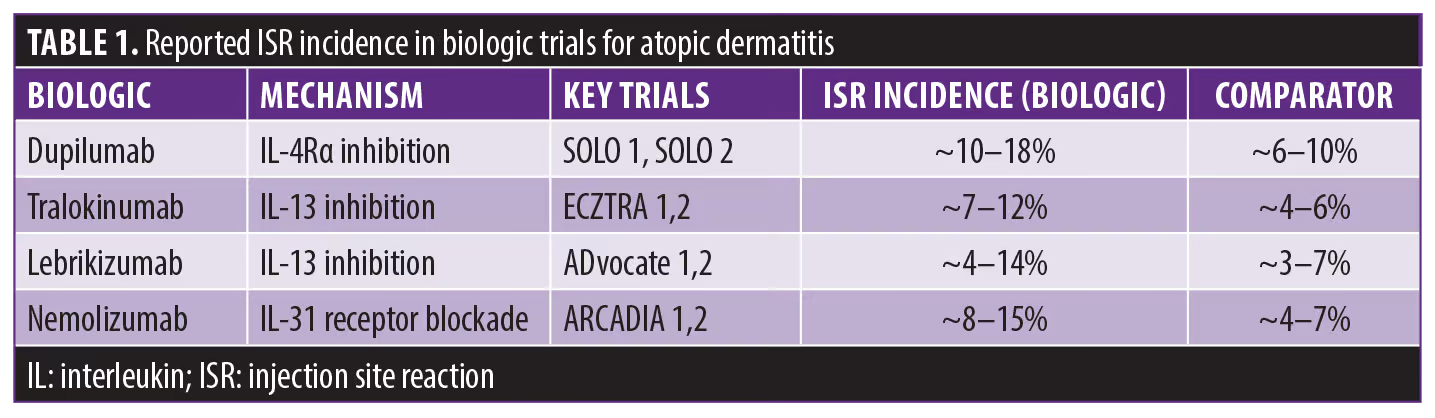
Across pivotal randomized clinical trials of type 2 pathway biologics for AD, injection site reaction incidence ranged from approximately 4% to 18% (Table 1). IL-4/IL-13 pathway inhibition demonstrated ISR rates of approximately 10% to 18% compared with 6% to 10% in placebo arms.1 Selective IL-13 inhibitors have demonstrated ISR rates ranging from approximately 4% to 14%, while IL-31 receptor blockade trials have reported localized reactions in approximately 8% to 15% of participants.2–4
After evaluation of multiple trials,1–6 ISRs most commonly presented as localized erythema, swelling, or tenderness occurring within the first several injections and typically resolving within several days. Serious injection-related complications were rare, and the majority of events were classified as grade 1 or 2 in severity.
Real-world observational studies and meta-analyses confirmed that the majority of ISRs were mild to moderate in severity, transient in duration, and rarely resulted in treatment discontinuation, with discontinuation rates generally reported between 1% and 2%.5,6
Discussion
ISRs represent the most common localized AEs associated with biologic therapies used in the treatment of atopic dermatitis. While numerically common, these reactions are typically benign and self-limited, rarely necessitating treatment discontinuation. Their clinical relevance lies less in physiologic severity than in their potential impact on patient adherence and treatment persistence in chronic diseases requiring long-term injectable therapy.
The pathophysiology of ISRs is multifactorial and incompletely understood. Proposed mechanisms include localized immune activation following subcutaneous monoclonal antibody administration, complement activation, mast cell degranulation, and cytokine release within the dermal microenvironment. In addition to immune-mediated factors, formulation characteristics—including injection volume, viscosity, pH, osmolarity, and excipient composition—might contribute to localized tissue irritation.5,6
Delivery device characteristics might further influence ISR incidence. Autoinjector design, needle gauge, injection speed, and medication temperature at the time of administration can affect both tissue dispersion and patient perception of injection discomfort.5,6 Variability in ISR incidence observed across clinical trials might therefore reflect differences in formulation and delivery devices rather than clinically meaningful differences in systemic safety profiles.
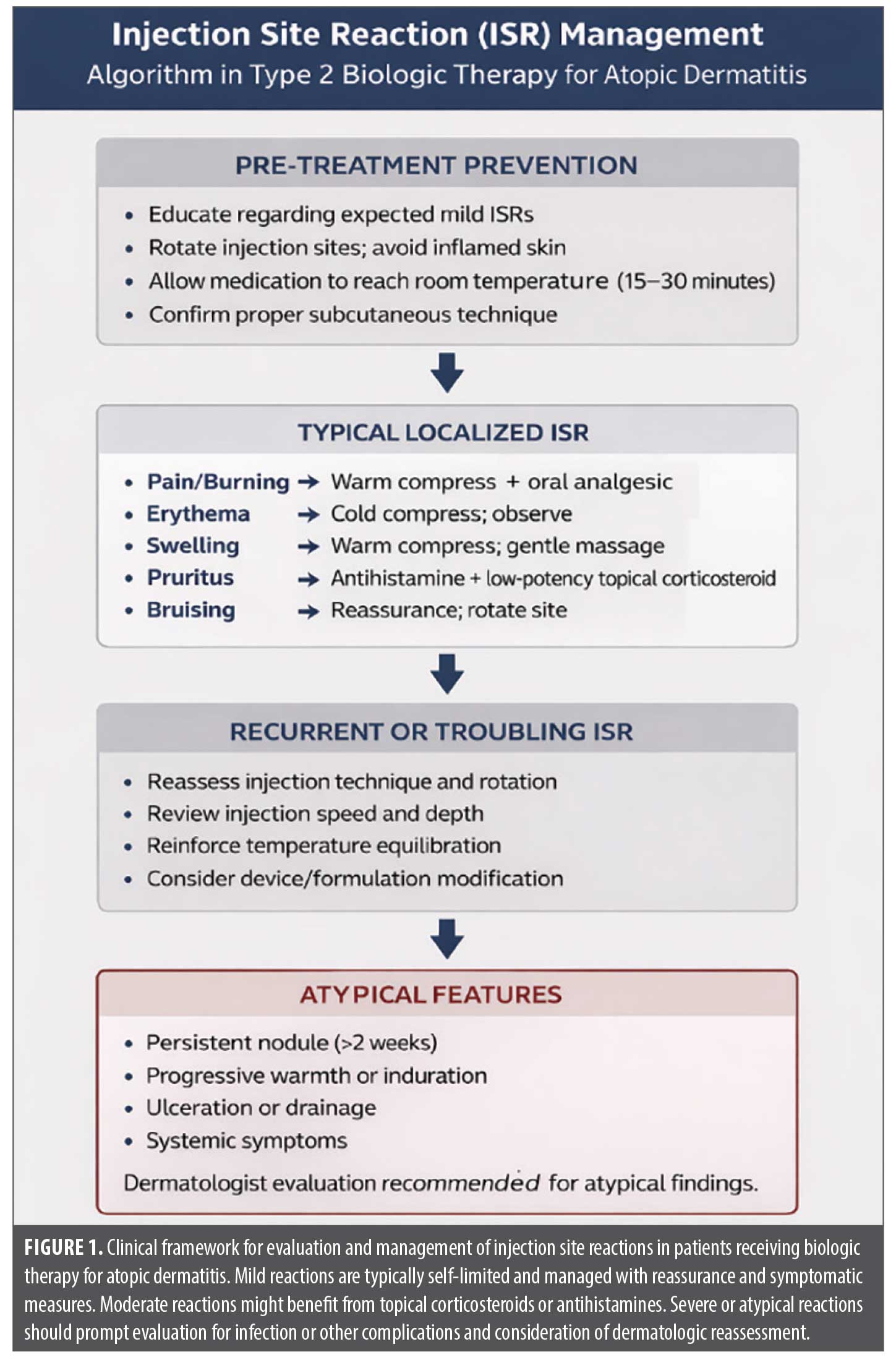
From a clinical perspective, anticipatory patient counseling represents one of the most effective strategies for mitigating the perceived severity of ISRs. Normalizing the possibility of mild erythema, swelling, or tenderness prior to therapy initiation can reduce anxiety-driven discontinuation. Practical measures such as allowing medication to reach room temperature prior to injection, rotating injection sites, and utilizing cold compresses or topical corticosteroids when necessary can further improve tolerability.
The proposed algorithm provides a structured framework for evaluating ISR severity and guiding management decisions in routine dermatologic practice (Figure 1). Importantly, most reactions can be managed conservatively without interrupting biologic therapy. Standardized documentation and counseling protocols can further help clinicians distinguish between benign localized reactions and rare complications, such as infection or hypersensitivity reactions.
The expanding integration of ACPs into dermatology care teams underscores the importance of standardized protocols for counseling, documentation, and management of biologic-associated AEs. As specialty medication prescribing continues to grow within dermatology practice, structured management pathways might help ensure consistent patient education and optimize long-term treatment adherence.
Conclusion
Biologic therapies for AD have become an integral component of modern dermatologic care and are increasingly prescribed and managed by dermatologists, PAs, and NPs. Understanding the clinical characteristics of ISRs and proactively counseling patients regarding this common AE are essential to maintaining treatment adherence and avoiding unnecessary discontinuation.
As additional injectable biologic therapies continue to enter the dermatologic therapeutic landscape, it will be increasingly important for dermatology providers to maintain familiarity with the prevention and management of ISRs. Incorporating routine counseling and standardized management strategies into clinical practice might improve patient confidence, enhance treatment persistence, and optimize long-term therapeutic outcomes.
References
- Simpson EL, Bieber T, Guttman-Yassky E, et al. Two phase 3 trials of dupilumab versus placebo in atopic dermatitis. N Engl J Med. 2016;375(24):2335–2348.
- Ständer S. Atopic dermatitis. N Engl J Med. 2021;384(12):1136–1143.
- Silverberg JI, Guttman-Yassky E, Thaçi D, et al. Two phase 3 trials of lebrikizumab for moderate-to-severe atopic dermatitis. N Engl J Med. 2023;388(12):1080–1091.
- Kabashima K, Matsumura T, Komazaki H, Kawashima M. Trial of nemolizumab and topical agents for atopic dermatitis with pruritus. N Engl J Med. 2020;383(2):141–150.
- Martora F, Patruno C, D’Ascenzo S, Napolitano M. Injection site reactions after dupilumab or tralokinumab for atopic dermatitis. J Dermatol Treat. 2024;35(1):2304027.
- Kim PJ, Lansang RP, Vender R. A systematic review and meta-analysis of injection site reactions in randomized-controlled trials of biologic injections. J Cutan Med Surg. 2023;27(4):358–367.
- Kong EL, Mostaghimi A. Advanced practice clinicians and dermatology drug spending. JAMA Dermatol. 2026;62(2):207–209.
- Abraham I, Adamson AS, Shinkai K. Biologics prescribing in dermatology by advanced practice clinicians-trends in the practice of advanced practice clinicians in dermatology. JAMA Dermatol. 2026;162(2):209–210.
From the 2nd Annual RAPIDS Immuno-Dermatology Conference: From Approval to Adoption—Translating Innovation Into Clinical Practice