
Celebrity Influence on Public Health: The Kardashians and Melanoma
J Clin Aesthet Dermatol. 2026;19(6):13–14.
Dear Editor:
On May 25, 2023, Season 3 of The Kardashians premiered, announcing Khloé Kardashian’s melanoma diagnosis and highlighting her postoperative course. Melanoma incidence has steadily increased for several decades and carries the highest mortality rate per case of all skin cancers.1 Melanoma upstaging confers over a 3-fold increase in mortality risk, underscoring the critical importance of public health awareness, early detection, and screening efforts.2
Wikipedia pageviews and Google Trends data were evaluated during the 2-week periods before and after the release of The Kardashians Season 3 to assess whether publicization of Khloé Kardashian’s melanoma diagnosis was associated with increased interest in skin cancer.3,4
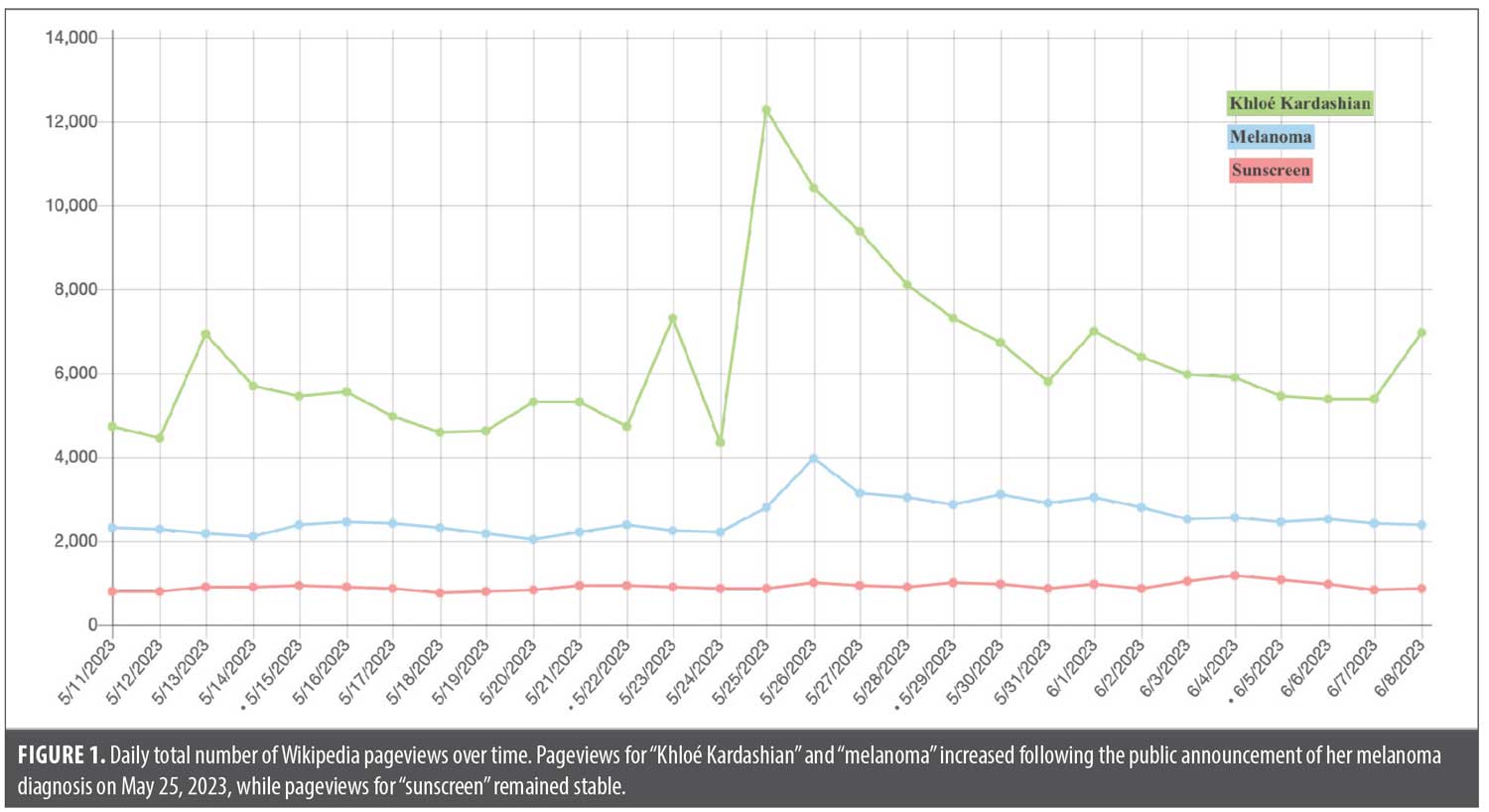
Wikipedia pageviews for “Khloé Kardashian,” and “melanoma,” each rose sharply within 1 day of the episode release date and remained substantially elevated for 3 to 7 days, while “sunscreen” pageviews remained low throughout the study period (Figure 1).
Similarly, Google searches for “Khloé Kardashian” and “melanoma” peaked 1 day after the release (Figure 2). Google Trends settings were selected as web searches in all categories in the United States. In contrast to Wikipedia pageviews, Google searches for “sunscreen” peaked 2 days later, although exhibiting greater variability over time.
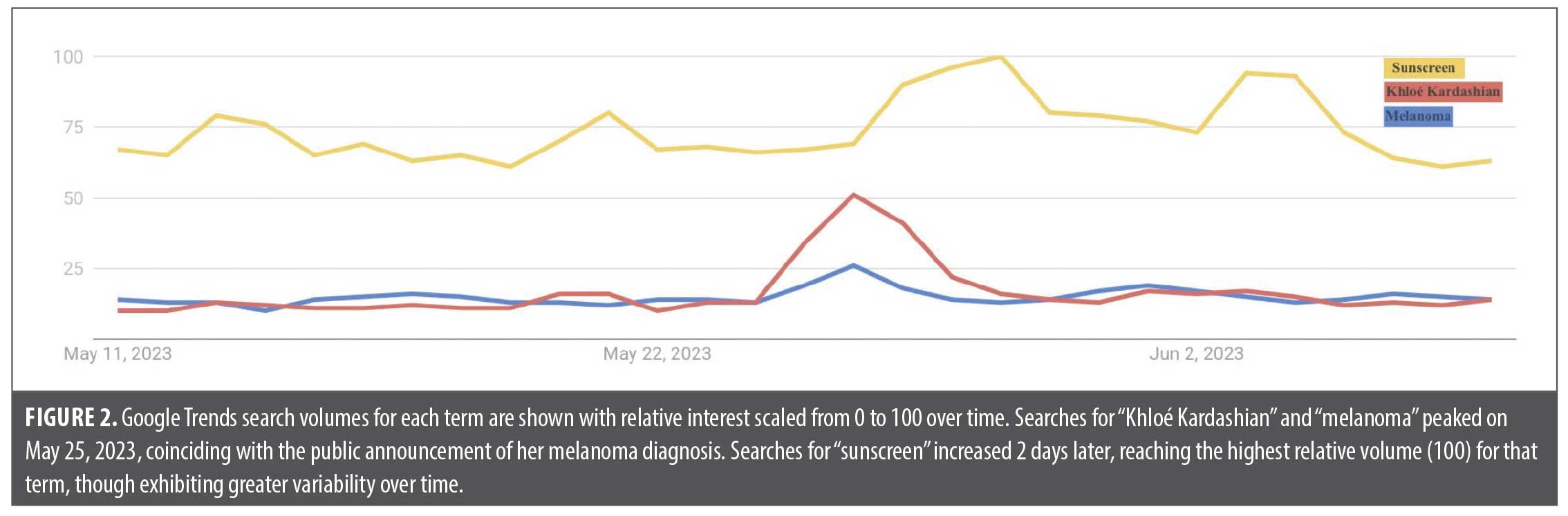
Other search terms including “skin cancer check,” “skin cancer screening,” “skin cancer prevention,” “dermatologist near me,” “skin check,” and “full body skin exam” remained at a relative interest score of 0, indicating no measurable increase. Likewise, “sunblock” and “spf” remained constant at a low search volume index. Google search and Wikipedia data from 2022 and 2024 did not reveal a similar concurrent spike in “melanoma” or “Khloé Kardashian”, suggesting compounding seasonal or annual factors were noncontributory.
Limitations include the relative nature of Google Trends data, whereas Wikipedia pageviews represent absolute counts. While correlation cannot confirm causation, these findings, along with previous celebrity health disclosures demonstrate how celebrity disclosures amplify public attention to health topics. It is unclear whether these search results are amplified by advertising of The Kardashians or timely public health efforts in response to smaller scale efforts by skin cancer organizations.
These findings highlight a strategic opportunity to deliver impactful public health education during periods of heightened public interest. Although searches for “melanoma” and “Khloé Kardashian” increased following her diagnosis announcement, there was no corresponding spike in “sunscreen” or “sunblock,” or various other skin cancer screening searches, suggesting a missed opportunity for prevention-focused public health messaging. Physicians, medical societies, and advocacy groups can leverage these moments to deliver prevention-focused education. Beyond disseminating information, such efforts contribute to the normalization of skin cancer screenings and skin cancer diagnoses. Additionally, the prolonged screentime of the postoperative period, dressings, and scar therapies on the show normalizes treatment experiences for the general public. Physician participation is essential not only for guiding accurate representation but also for fostering informed dialogue, providing medically accurate information, and encouraging behavior change during these critical windows of attention.
With regard,
Mojan Deriss, PA-C; Cybil Sierra Stingl, MD; and Nour Kibbi, MD
Keywods: Melanoma, public health, celebrity influence, search behavior, infodemiology
Affiliations: Ms. Deriss is a medical student with Roseman University College of Medicine, Las Vegas, Nevada. Dr. Stingl is with the Division of Plastic and Reconstructive Surgery, Department of Surgery, Stanford School of Medicine, Stanford, California. Dr. Kibbi is with the Department of Dermatology, Department of Medicine, Stanford School of Medicine, Stanford, California.
Funding: No funding was provided for this article.
Disclosures: The authors have no relevant conflicts of interest.
Correspondence: Mojan Deriss, PA-C;
References:
- Heistein JB, Acharya U, Mukkamalla SKR. Malignant melanoma. In: StatPearls [Internet]. StatPearls Publishing; 2026 Jan-. Updated 17 Feb 2024. Accessed 5 October 2025. https://www.ncbi.nlm.nih.gov/books/NBK470409/
- Goldberg R. Tumor upstaging in invasive melanoma linked to worse survival outcomes. Dermatology Advisor. 7 Jan 2025. Accessed 5 October 2025. https://www.dermatologyadvisor.com/news/tumor-upstaging-invasive-melanoma-linked-worse-survival-outcomes/
- Google Trends. Accessed 5 October 2025. https://trends.google.com/trends
- Pageviews Analysis. Accessed 5 October 2025. http://pageviews.toolforge.org
- Sajjadi NB, Feldman K, Shepard S, et al. Public interest and behavior change in the United States regarding colorectal cancer following the death of Chadwick Boseman: infodemiology investigation of internet search trends nationally and in at-risk areas. JMIR Infodemiol. 2021;1(1):e29387.
From the 2nd Annual RAPIDS Immuno-Dermatology Conference: From Approval to Adoption—Translating Innovation Into Clinical Practice