
J Clin Aesthet Dermatol. 2025;18(11):10–11
The Experiences of Black Dermatology Faculty in the United States
Dear Editor:
Dermatology is among the least diverse specialties in medicine. As of 2023, only 3.6% of American dermatologists identified as Black or African American.1 Furthermore, Black dermatologists comprise only 3% of faculty at academic dermatology programs, significantly underrepresenting the 13.7% of African Americans in the United States.2
This cross-sectional survey study sought to characterize the experiences of full-time Black academic dermatologists in the United States. Ninety-seven Black academic dermatologists were identified using Black Derm Directory (an online directory of self-identified Black practicing dermatologists), academic program websites, and the authors’ knowledge of faculty full-time status and racial identity.
Of 52 survey respondents (Table 1), 75% were female. The majority reported that an academic position was their first physician job after training (86.3%), and most were not on a tenure track (80.4%). The most common departmental rank held was assistant professor (42.3%) followed by associate professor (32.7%). Approximately one-third were fellowship-trained (37.3%), most commonly in pediatrics (n=7). On average, respondents spent most clinical time on outpatient care (mean: 89.7%; SD: 20.6%). Approximately three-quarters ran specialty clinics (n=40), with the most common focus being skin of color (n=15), followed by hair (n=12) and hidradenitis suppurativa (n=7).
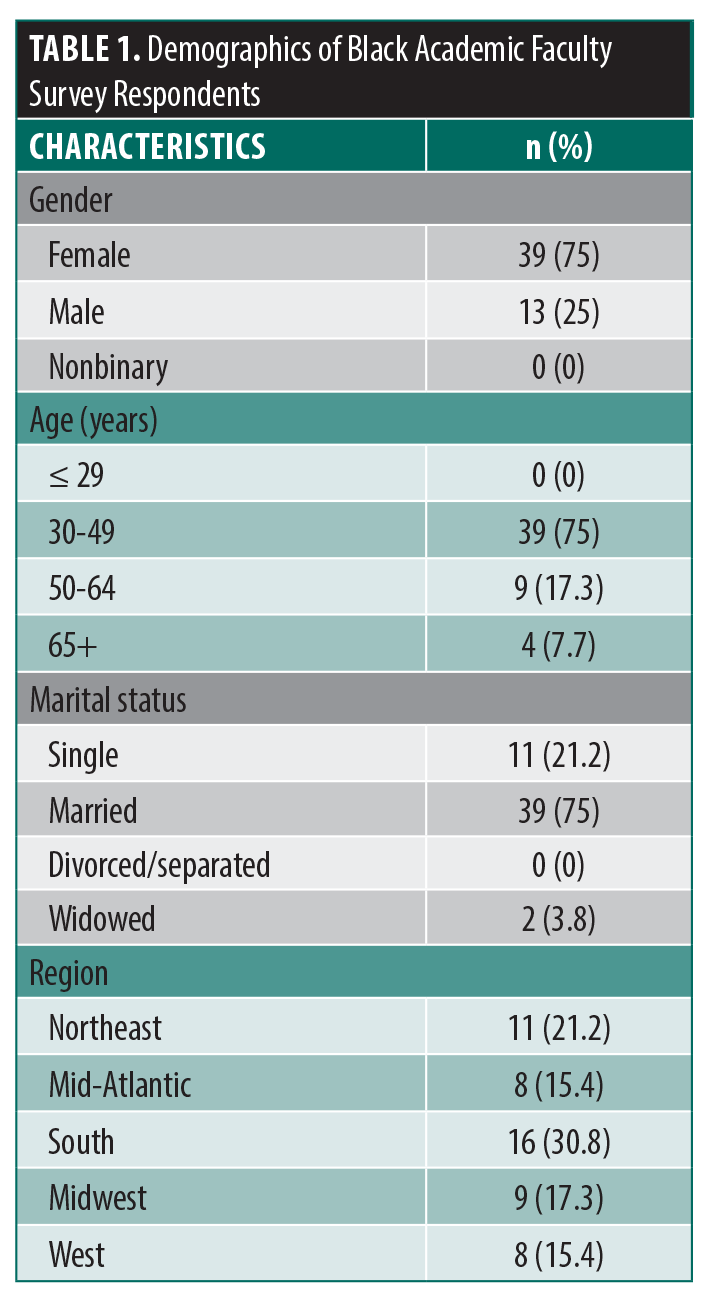 The majority held departmental or institutional leadership roles (70.6%), one-third related to diversity, equity, and inclusion, and a majority also held leadership roles outside their institutions (61.5%). The most common society memberships were the American Academy of Dermatology and the Skin of Color Society. Of those without leadership roles (n=15), two-thirds desired leadership opportunities.
Just over half reported working between 40 and 60 hours per week (n=26). Respondents reported considerable heterogeneity in their proportions of protected time (mean: 23.5%; range: 0-100%). Over half agreed their professional demands allowed for adequate work-life balance (54%) while 28% disagreed.
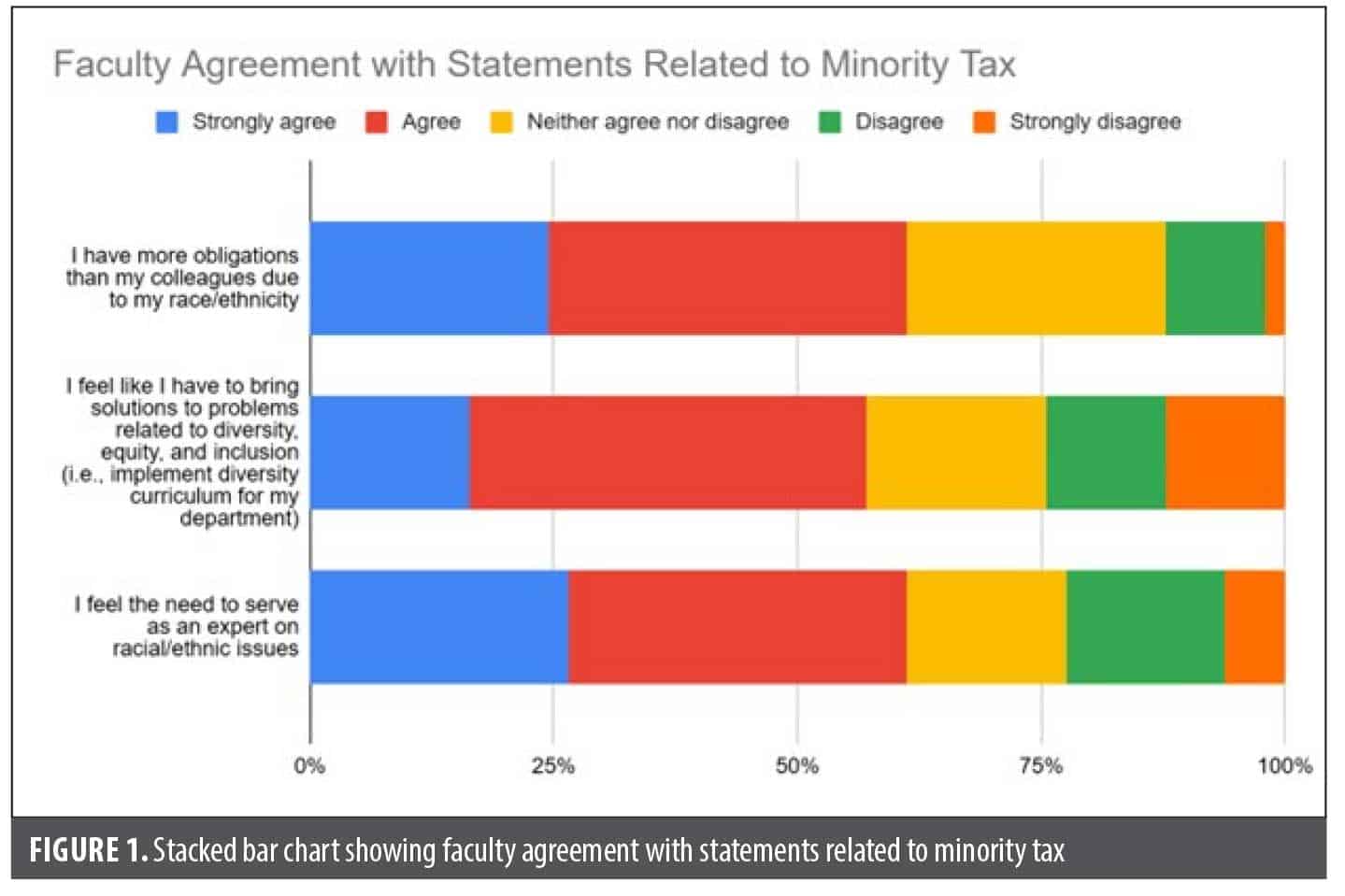
Most respondents felt supported by their departmental leadership (92%). However, 61.2% (n=30) felt they had more obligations than colleagues due to their race, and 57.1% (n=28) experienced inadequate recognition of their work. More specifically, 57.1% reported being tasked with bringing solutions to problems related to diversity, equity, and inclusion despite only 23.5% having formal roles related to this space (Figure 1). While the majority were satisfied with their current work setting and professional practice (n=37; 75.5%), nearly half (n=24, 49%) reported being tempted to leave academia. Approximately one-third (n=24, 34.7%) reported experiencing one or more symptoms of burnout.
Limitations of this study include survey nonresponse bias and the process for identifying Black faculty and their respective email addresses. Future research on this topic may use interviews and focus groups to capture more in-depth and nuanced information.
Black academic dermatologists are predominantly female and appear to carry an increased burden of responsibility and informal work related to diversity, equity, and inclusion. Formal recognition, protected time, and resources to support this work are needed. Furthermore, avoidance of this work for those without formal roles is important to mitigate minority tax. Academic dermatology programs should continue to support recruitment and retention efforts for underrepresented faculty, and additional efforts are needed to recruit and retain Black men in particular.
With regard,
Kara Turner, BA; Abdulaziz Hamid, BS; Victoria Barbosa, MD, MPH; Susan Taylor, MD; and; Nada Elbuluk, MD, MSc
Keywords. Academia, faculty, Black faculty, academic medicine, academic dermatology, recruitment, retention
Affiliations. Ms. Turner is with the Albert Einstein College of Medicine in Bronx, New York. Mr. Hamid is with the Medical College of Wisconsin in Milwaukee, Wisconsin. Dr. Barbosa is with the Section of Dermatology at the University of Chicago Medicine in Chicago, Illinois. Dr. Taylor is with the Department of Dermatology at the Perelman School of Medicine at the University of Pennsylvania in Philadelphia, Pennsylvania. Dr. Elbuluk is with the Department of Dermatology at the Keck School of Medicine at the University of Southern California in Los Angeles, California.
Funding. No funding was provided for this article.
Disclosures. Dr. Elbuluk has served as a consultant, advisory board member, and/or speaker for AbbVie, Avita Medical, Beiersdorf, Canfield Scientific, Dior, Galderma, Incyte, Janssen, Kao, La Roche-Posay, Lilly, L’Oréal, McGraw Hill, Medscape, Pfizer, Sanofi, Scientis, Takeda, Unilever, and VisualDx. She has received royalties from McGraw-Hill. She has stock options in VisualDx. Dr. Barbosa has served as a consultant, advisory board member and/or speaker for Beiersdorf, Johnson & Johnson, Lilly, L’Oreal, Pfizer, UCB, and Vichy. Dr. Taylor has served as a consultant, advisory board member, and/or speaker for AbbVie, Arcutis, Armis Scientific, Avita, Beiersdorf, Biorez, Bristol-Myers Squibb, Cara Therapeutics, Dior, EPI Health, Evolus, Galderma, GloGetter, Hugel America, Incyte, Johnson & Johnson, Lilly, L’Oreal USA, MedScape, MJH LifeSciences, Pfizer, Piction Health, Sanofi, Scientis US, UCB, and Vichy Laboratories. She has received royalties from McGraw-Hill. She has served as an investigator for Allergan, Concert Pharmaceuticals/Sun Pharma, Croma-Pharma GmbH, Lilly, and Pfizer. The remaining authors have no disclosures to report.
References:
- US physician workforce data dashboard. Association of American Medical College. Accessed May 14, 2025.
- Gonzalez S, Syder N, McKenzie SA, Price KN, et al. Racial diversity in academic dermatology: a cross-sectional analysis of Black academic dermatology faculty in the United States. J Am Acad Dermatol. 2024;90(1):182-184.