
J Clin Aesthet Dermatol. 2025;18(11–12 Suppl 1):S30–S31.
by Archana M. Sangha, MMS, PA-C
Ms. Sangha is a senior medical science liaison for Incyte Corporation in Wilmington, Delaware. Prior to that, she spent over a decade as a dermatology PA specializing in general, surgical, and cosmetic dermatology. She is a fellow of the American Academy of Physician Assistants in Alexandria, Virginia. She is also a Past President of the Society of Dermatology Physician Assistants.
Introduction
Alopecia areata (AA) is estimated to impact nearly two percent of the worldwide population.1 Here in the United States (US), incidence rates were found to be higher in skin of color (SOC) patients compared to White patients. In a cross-sectional study of over 1,800 patients, one study found that relative to White patients, the standardized prevalence rates of AA were higher in Asian (2.47), Black (1.35), and Hispanic/Latino (1.26) patients.2 This article will highlight three clinical pearls for diagnosing and managing AA in SOC populations.
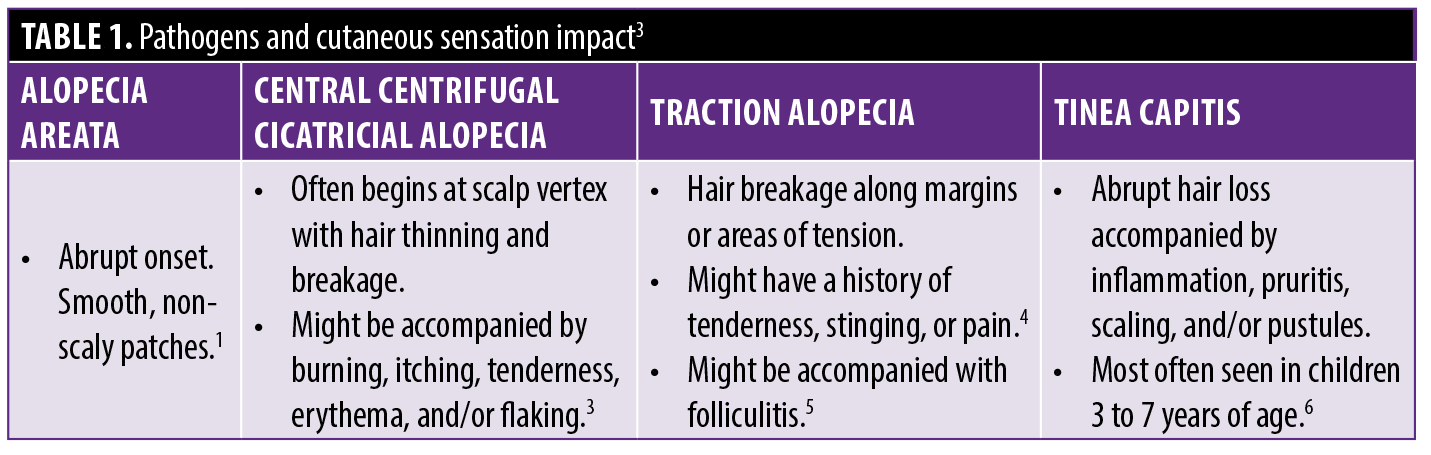
1. Differentiate from other causes of alopecia. Early on, AA can commonly mimic central centrifugal cicatricial alopecia (CCCA), traction alopecia, and tinea capitis. See Table 1 for key features to differentiate AA.1–6
2. Provide culturally competent care. Familiarize yourself with various cultural practices. For example, one study found that over 60 percent of White women wash their hair every other day, whereas 50 percent of Black women washed their hair every two weeks.7 Ask patients how often they wash their hair in a month instead of in a week.
Ask about haircare practices. Chemical relaxers, tight braids, and frequent heat styling have been shown to worsen inflammation and hair breakage, thus complicating hair regrowth.8,9 While avoidance of these haircare practices is preferred, it’s important to avoid placing blame on patients. Practicing compassionate care and a willingness to “listen to understand” and not “listen to blame” is fundamental to building patient trust. One study of 200 Black women showed that nearly 70 percent believed their physician did not have a good understanding of African American hair.10
You can gently ask patients if they would consider alternate styling practices that wouldn’t hinder hair regrowth, or if they would consider modifications to their current practices.9
3. Nuances to consider in SOC. Intralesional steroid injections remain first-line treatment for localized AA. It’s important to remember their risk of hypopigmentation, especially when treating SOC patients. To minimize the risk, it might be prudent to consider using lower concentrations in cosmetically sensitive areas.11
Trichoscopic analysis is a noninvasive tool that can be used to aid in the diagnosis and monitoring of AA. Common trichoscopic features seen in AA include yellow dots, black dots, exclamation mark hairs, and short vellus hairs. A recent study of trichoscopic analysis of Black patients with AA found novel features such as peripilar hyperpigmentation, follicular hypopigmentation, diffuse erythema, uninterrupted honeycomb patterns, and perifollicular scaling.12 Another study of Asian-Indian patients found features such as tapered, coudability, and pigtail hair.13 More studies in a variety of ethnicities are needed to better understand potential nuances in trichoscopic patterns.
References:
- Pratt CH, King LE Jr, Messenger AG, et al. Alopecia areata. Nat Rev Dis Primers. 2017;3:17011.
- Sy N, Mastacouris N, Strunk A, Garg A. Overall and racial and ethnic subgroup prevalences of alopecia areata, alopecia totalis, and alopecia universalis. JAMA Dermatol. 2023;159(4):419–423.
- Aguh C, McMichael A. Central centrifugal cicatricial alopecia. JAMA Dermatol. 2020;156(9):1036.
- Larrondo J, McMichael AJ. Traction alopecia. JAMA Dermatol. 2023;159(6):676.
- Syed HA, Kaliyadan F. Traction alopecia. Updated 4 May 2025. StatPearls Publishing. https://www.ncbi.nlm.nih.gov/books/NBK470434/
- Clebak KT, Malone MA. Skin infections. Prim Care. 2018;45(3):433–454.
- Lewallen R, Francis S, Fisher B, et al. Hair care practices and structural evaluation of scalp and hair shaft parameters in African American and Caucasian women. J Cosmet Dermatol. 2015;14(3):216–223.
- Shetty VH, Shetty NJ, Nair DG. Chemical hair relaxers have adverse effects a myth or reality. Int J Trichology. 2013;5(1):26–28.
- Mayo TT, Callender VD. The art of prevention: It’s too tight-loosen up and let your hair down. Int J Womens Dermatol. 2021;7(2):174–179.
- Gathers RC, Mahan MG. African American women, hair care, and health barriers. J Clin Aesthet Dermatol. 2014;7(9):26–29.
- Kumaresan M. Intralesional steroids for alopecia areata. Int J Trichology. 2010;2(1):63–65.
- Pyles J, Palmer V, Balding E, et al. Alopecia areata in skin of color: trichoscopic analysis in Black/African American patients. J Drugs Dermatol. 2025;24(7):708–712.
- Mani S, Raut A, Neema S, et al. Trichoscopy in alopecia areata and trichotillomania in skin of colour: a comparative study. Indian J Dermatol. 2023;68(1):78–84.